
Process Technology · Emission Control
Absorption-liquid monitoring and inline analysers: two routes to demonstrable compliance, and the case for applying both.
Two established strategies exist for verifying the performance of a wet gas scrubber: continuous monitoring of the absorption-liquid parameters, and direct measurement of the treated gas. This article examines the operating principle, instrumentation and regulatory implications of each, and the case for their combined application.
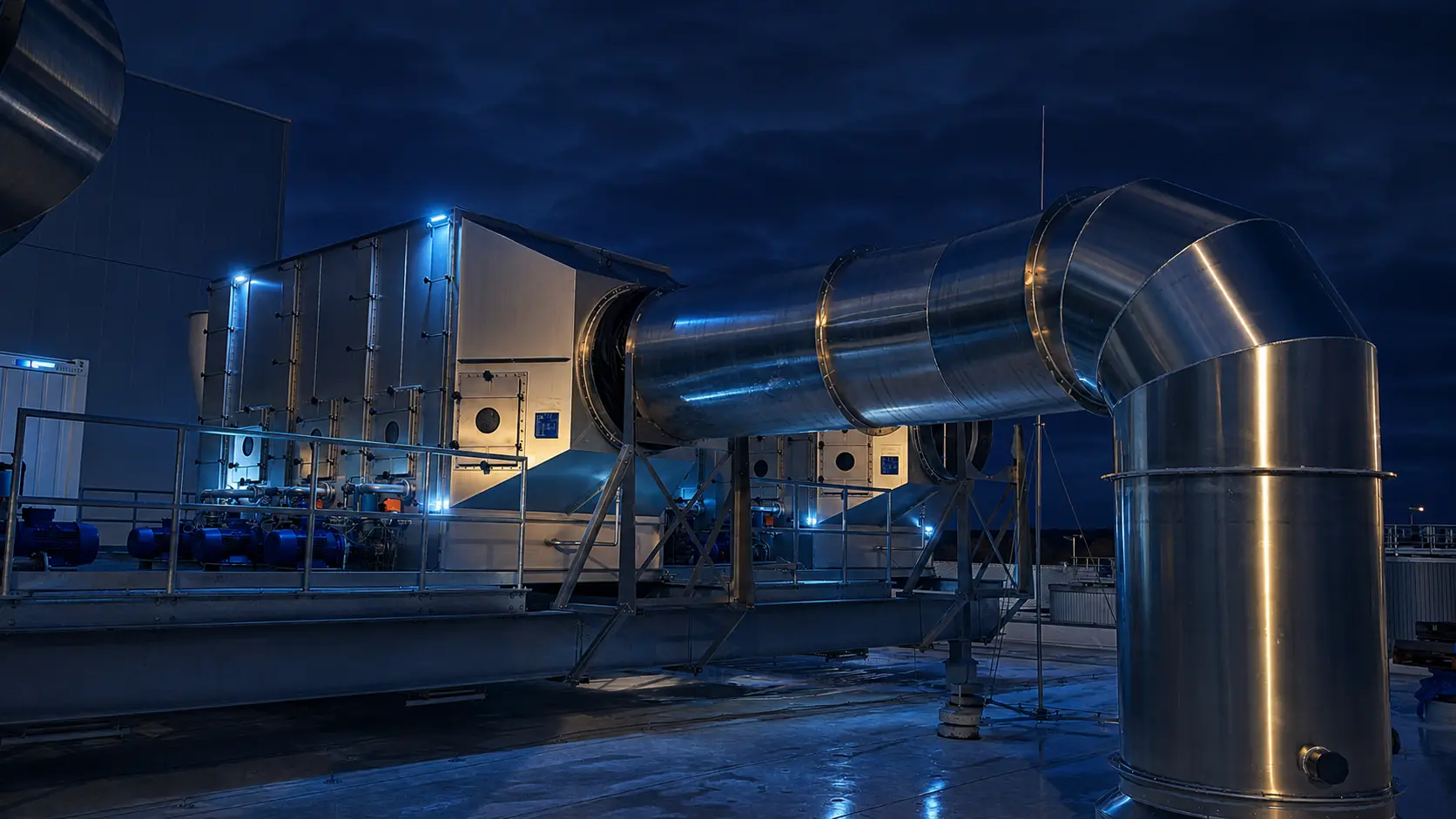
01 Legislation and the compliance obligation
Increasingly stringent environmental legislation — notably the European Industrial Emissions Directive (IED, 2010/75/EU) — imposes rising demands on industrial operators to demonstrate continuous compliance with emission limit values. In sectors ranging from chemical manufacturing and power generation to food processing and waste treatment, the wet gas scrubber remains one of the most widely applied technologies for removing gaseous and particulate pollutants from a process gas stream. The gas is brought into intimate contact with an absorption liquid, contaminants are absorbed or neutralised in the liquid phase, and the treated gas is discharged to the stack.
Removal of the pollutant is, however, only part of the operator's obligation. Compliance must also be demonstrated continuously and to the satisfaction of the permitting authority. Two established methodologies address this verification requirement, and they differ fundamentally in principle.
The first infers the emission indirectly from the condition of the absorption liquid; the second measures the residual contaminant concentration in the gas directly. Selecting the appropriate method for a given application — and understanding how the two reinforce one another — is decisive for reliable, demonstrable compliance.
02 Inside the open spray scrubber
Of the wet scrubber configurations in common industrial use, the open spray scrubber is the simplest in construction and among the most versatile in application. The gas stream enters a hollow vessel — an open tower containing neither packing nor internal obstructions — in which an array of spray nozzles atomises the absorption liquid into a dense field of fine droplets. As the gas rises through this droplet field, gaseous pollutants are absorbed into the liquid phase and particulates are captured on the droplet surfaces; the treated gas leaves at the top of the vessel while the spent liquid drains to the sump for recirculation or blowdown.
The absence of internals gives the open design a high tolerance to elevated dust loads and to sticky or fouling contaminants that would rapidly plug a packed bed. It also operates at low pressure loss, reducing fan energy consumption and operating cost, and its installation and maintenance requirements are comparatively modest.
The corresponding limitation is that mass transfer depends entirely on the liquid distribution. Overall performance is governed by the nozzles — specifically their droplet size distribution, spray pattern, droplet kinetic energy, liquid flow rate and, above all, their positioning within the absorption stage, which together determine the completeness of gas–liquid contact.
Strengths of the open design
- High tolerance to elevated dust loads
- Handles sticky and fouling contaminants
- Low pressure loss, so lower fan energy
- Modest installation and maintenance demands
What performance depends on
- Droplet size distribution and spray pattern
- Kinetic energy of the droplets
- Liquid flow rate
- Nozzle positioning within the absorption stage
Correct nozzle configuration is therefore the decisive factor in converting a simple empty tower into an efficient gas-cleaning device.
03 Where Lechler excels: open spray systems meet high-end analysers
Lechler's distinctive capability lies in addressing both halves of the problem within a single engineered scope. As a spray-technology specialist and a manufacturer of bespoke wet gas scrubbers, Lechler designs and integrates the open spray scrubber and the emission-verification system as one integrated package. Each scrubber is engineered to order around the customer's gas composition, contaminant load and regulatory duty; it is not a catalogue unit reconfigured to fit. Because cleaning efficiency in an open spray tower is determined almost entirely by the spray, this is where Lechler's core expertise is concentrated: removable spray-lance assemblies fitted with co-current and counter-current nozzles, positioned to maximise contact between the absorption liquid and the process gas.
This optimised spray stage is complemented by direct gas measurement. Rather than relying on liquid-phase proxies alone, Lechler Process Technology integrates inline dust analysers and gas analysers — including Fourier-transform infrared (FTIR) instrumentation — into the scrubber discharge and control system. FTIR is particularly well suited to this duty: it resolves multiple gas components simultaneously and in real time, reducing the need for a dedicated analyser per pollutant while generating the detailed data records required for regulatory reporting. Because the analyser is coupled to the scrubber control system, the measured emission value can be used directly to actuate the blowdown of the absorption liquid, closing the control loop between the actual stack emission and the operation of the scrubber.
The outcome is a single-source solution. The open spray scrubber provides robust, low-pressure-loss cleaning that tolerates high dust loads and fouling contaminants, while the integrated analysers provide continuous, high-accuracy verification that emissions remain below the limit value, together with direct feedback control when concentrations begin to drift. The customer receives one engineered system. It is this combination of spray-technology expertise and modern analyser instrumentation that enables industrial operators to meet increasingly stringent environmental legislation reliably and cost-effectively.
04 Scrubber technology and measurement know-how
The two disciplines rarely reside within a single company. Spray-technology specialists understand droplet formation, nozzle behaviour and interfacial contact, but treat the analyser as a bought-in component; instrumentation manufacturers understand ppm-level measurement and sample conditioning, but do not design scrubber internals. The operator is usually left to integrate the two, taking on responsibility for every interface between them. Lechler occupies the uncommon middle ground, commanding both the open spray absorption technology that removes the contaminant and the measurement expertise, based on high-end analysers, which verifies its removal.
This dual competence has direct practical consequences. Because Lechler designs and builds the spray stage, the behaviour of the open scrubber is known in detail, and because Lechler Process Technology also specifies and builds in the analysers, the measurement can be placed where it is most representative, fed directly into blowdown control, and the whole loop calibrated as a single instrument. Absorption performance and measurement accuracy are engineered to the same specification, from a single source. For the operator, this consolidates what would otherwise be split between scrubber supplier and instrument supplier into one point of accountability, integrating two separately optimised components into one demonstrably compliant system.
05 Indirect emission control: absorption-liquid monitoring
The most widely applied approach does not measure the gas at all. It rests on a well-established premise: the condition of the absorption liquid is related to the quality of the treated gas. As the liquid becomes saturated or chemically depleted, its capacity to absorb further contaminants declines, and emission concentrations rise correspondingly.
The method is, by definition, indirect: it does not measure the emission but is a proxy for it. Before the installation enters permanent operation, a correlation must be established between the gas emission limit value and the corresponding absorption-liquid parameter. This is typically achieved during a commissioning period in which the liquid settings are varied experimentally and validated against reference emission measurements or gas sampling. Only once this correlation has been established can the plant be operated continuously against defined liquid-phase setpoints.
In practice, indirect monitoring provides an inferred emission value that is only as reliable as the correlation on which it is based, whereas direct measurement provides the emission value itself. The selection of sensors is dictated by the chemistry of the process: the contaminants present in the waste gas and the reagents used to neutralise them determine the required instrument set.
06 Direct emission control: inline gas analysers
The alternative approach eliminates the inference. An inline analyser installed in the discharge duct downstream of the scrubber measures the residual contaminant concentration in the treated gas in real time. No correlation need be established and no proxy interpreted; the emission value is directly readable at all times.
The benefit is both operational and regulatory. Because the reading reflects the actual emission, the scrubber blowdown can be actuated directly from it, adjusting liquid quality to prevailing conditions. Moreover, no exceedance can occur undetected: the operator, the permitting authority and the environmental inspectorate all have access to the same unambiguous measured value.
Dust analysers
For particulate emissions, a probe-based analyser provides a direct readout of total dust concentration, constituting the final verification that particulate emissions remain below the applicable limit value.
Trend monitoring
These probes are an advanced development of tribo-electric probes, which have long been used to monitor filter systems in industrial processes. They perform reliably in dry processes and accurately detect increases in dust levels. A sustained rise in the dust concentration within the duct indicates a problem or the rupture of one or more filters. The most basic sensor only triggers an alarm. In most applications, however, a sensor with a 4–20 mA output is used, allowing the dust concentration trend to be tracked over time. These probes are also available with ATEX certification.
Certified emission monitoring
The QAL dust monitor is a TÜV-certified QAL1 probe, which qualifies it as an official instrument for continuous dust emission monitoring. The certification covers the ranges 0–7.5, 0–15 and 0–100 mg/m³. The probe provides two relay outputs and a 4–20 mA output and is equipped with an RS485 interface using the MODBUS RTU communication protocol.
Online environmental dust monitoring
Online environmental dust monitoring relies on aerosol spectrometry, a technique that has become well established for the assessment of fine dust in both occupational and environmental settings. Continuous refinement of this technology has yielded accurate instruments capable of measuring dust and fine particulate concentrations across a wide range of workplace and outdoor environments.
Portable aerosol measurement
Portable aerosol spectrometers measure several mass concentrations simultaneously. These include workplace-relevant fractions (inhalable, thoracic and respirable) as well as environmental and indoor fractions (PM10, PM2.5 and PM1). Such instruments are well suited to field surveys and exposure assessments where mobility is required.
In addition to mass concentrations, these instruments provide particle-count data resolved across 31 channels corresponding to distinct particle-size classes. This level of size resolution makes them particularly valuable for research and development applications, including the evaluation of filter efficiency.
Particulate matter monitor — continuous stationary monitoring
For stationary monitoring, a compact monitor can be integrated into a weatherproof housing fitted with a heated inlet, providing a robust basis for continuous outdoor operation. Such units may optionally be equipped with an advanced meteorological sensor. This configuration is well suited to source-identification studies, in which the origin and dispersion of particulate matter are investigated.
Certified environmental fine dust monitor
Where continuous online fine dust monitoring is required, a range of configurations is available. These systems are generally equipped with durable pumps and components designed for uninterrupted 24/7 operation. At their core is typically a 19-inch rack-mounted monitor that can be installed in an analyser shelter, while mobile, climate-controlled cabinets allow deployment outdoors under all weather conditions. Certified instruments of this type meet the QAL1 standard for fine dust measurements of PM10 and PM2.5.
Continuous emission monitoring system (CEMS)
A continuous emission monitoring system (CEMS) enables the continuous, online recording of emission concentrations. In a typical configuration, the system is housed in a 19-inch analyser cabinet and comprises an industrial computer, a heated sampling system and a heated Fourier-transform infrared (FTIR) analyser. The configuration can optionally be extended with a flame ionisation detector (FID) for total hydrocarbon measurement and with an oxygen analyser.
Such systems can be certified to QAL1 in accordance with the relevant standards, allowing the simultaneous quantification of a wide range of gaseous emission components. Because the measurement relies on FTIR spectroscopy, the recorded infrared spectra provide detailed insight into the composition of the sampled gas. This makes it possible not only to quantify predefined target components, but also to identify previously unknown compounds and to perform retrospective quantitative analysis of additional components of interest. The measurement scope can generally be extended to further components through software configuration, without hardware modification.
Portable FTIR emission analysis
For periodic on-site measurements, a compact and fully equipped portable FTIR analyser with an integrated pump and heated sampling system can be employed. Portable analysers of this type may be certified to QAL1, and to EN 15267-4 for the simultaneous measurement of multiple emission components. An oxygen analyser can optionally be integrated into the sampling system. The analyser and its portable sampling system are heated so that the gas stream remains above its dew point both before and during analysis, preventing condensation and the associated loss of water-soluble components. Such systems are well suited to a broad range of process, emission and research applications.
Gaseous contaminants are measured continuously, with results expressed in ppm. Where extractive measurement is employed, a sample-conditioning system is required to address high gas temperature and elevated moisture content. At the high end, FTIR spectroscopy resolves multiple gas components simultaneously — acidic gases, hazardous compounds and greenhouse gases — within a single instrument designed for durability under harsh industrial conditions.
Portable flame ionisation detection (FID)
Portable flame ionisation detector (FID) instruments provide a reliable and robust means of measuring gaseous organic emissions during periodic emission control. Instruments of this class are designed to comply with established metrological standards for emission measurement, including EN 15267-4, EN 12619 and the QAL1 requirements defined in EN 14181, ensuring traceable and reproducible results under regulatory monitoring conditions.
Through an advanced sample-injection arrangement, such instruments can measure total organic carbon (TOC) and methane concentration simultaneously. A catalytic converter integrated into the instrument selectively removes non-methane organic compounds, allowing the methane (MHC) fraction to be determined directly. The non-methane hydrocarbon (NMHC) fraction is then obtained from the difference between the total organic carbon and the methane concentration, eliminating the need for separate sequential measurements.
Gas chromatography (GC)
Gas chromatography is a well-established analytical technique for the selective separation and quantification of volatile organic compounds. In the context of ambient-air monitoring, it is widely applied to the determination of the BTEX group — benzene, toluene, ethylbenzene and the xylene isomers — a set of aromatic hydrocarbons of particular concern because of their prevalence in industrial and traffic-related emissions and their known health effects.
For this application, a compact instrument combining a miniaturised gas chromatograph (micro-GC) with a photo-ionisation detector (PID) enables accurate and selective determination of BTEX concentrations in ambient air. The chromatographic separation ensures that individual compounds are resolved before detection, thereby avoiding the cross-sensitivities associated with non-selective sensing. Operating on a short measurement cycle, the instrument typically delivers a chromatogram together with the corresponding BTEX concentrations at intervals of the order of ten minutes, providing near-continuous time-resolved data.
Such instruments are generally equipped with standard communication interfaces, allowing integration into existing monitoring networks or connection to remote data-analysis platforms for centralised evaluation and storage.
| Instrument | Measures | Typical duty | Certification |
|---|---|---|---|
| Tribo-electric dust probe | Total dust concentration, trend | Continuous, in-duct | ATEX versions available |
| QAL dust monitor | Dust 0–7.5 / 0–15 / 0–100 mg/m³ | Continuous emission monitoring | TÜV-certified QAL1 |
| Portable aerosol spectrometer | Inhalable / thoracic / respirable, PM10, PM2.5, PM1, 31 size channels | Field surveys, exposure and filter-efficiency assessment | — |
| Environmental fine dust monitor | PM10, PM2.5 | Continuous outdoor, 24/7 | QAL1 |
| CEMS with FTIR | Multiple gaseous components, optional TOC and O₂ | Continuous online emission recording | QAL1-certifiable |
| Portable FTIR | Acidic gases, hazardous compounds, greenhouse gases | Periodic on-site measurement | QAL1, EN 15267-4 |
| Portable FID | TOC, methane and NMHC by difference | Periodic emission control | EN 15267-4, EN 12619, EN 14181 (QAL1) |
| Micro-GC with PID | BTEX in ambient air | Near-continuous, ~10-minute cycle | — |
07 Comparative assessment
The two strategies are complementary rather than mutually exclusive. In many installations, absorption-liquid monitoring serves as the primary operational control loop while an inline analyser provides continuous compliance verification and acts as a safeguard against undetected exceedances.
| Indirect — absorption liquid | Direct — inline analyser | |
|---|---|---|
| What is measured | Liquid-phase parameters as a proxy | Residual contaminant in the treated gas |
| Correlation required | Yes, established during commissioning | No, the emission value is read directly |
| Accuracy of the emission value | As reliable as the underlying correlation | The measured value itself |
| Blowdown control | Against liquid-phase setpoints | Actuated directly from the emission reading |
| Regulatory transparency | Inferred value, requires validation | One unambiguous value for all parties |
| Typical positioning | Cost-effective, mature, routine installations | Superior accuracy and immediate transparency |
Indirect monitoring is cost-effective, technically mature and well suited to a broad range of routine installations. Direct monitoring — by dust analyser, gas analyser or FTIR — offers superior accuracy, immediate regulatory transparency and closed-loop control of the blowdown. Under tightening regulatory frameworks such as the IED and the IMO sulphur cap, the combined application of both strategies represents the most robust basis for demonstrating continuous compliance.
Frequently asked questions
What is the difference between indirect and direct emission control?
Indirect emission control infers the emission from the condition of the absorption liquid, using liquid-phase parameters as a proxy. Direct emission control measures the residual contaminant concentration in the treated gas with an inline analyser, so the emission value is readable at all times without any proxy or correlation.
Why does absorption-liquid monitoring need a commissioning correlation?
Because the liquid parameter is not the emission. Before permanent operation, the liquid settings are varied experimentally and validated against reference emission measurements or gas sampling, establishing the relationship between the emission limit value and the corresponding liquid parameter. Only then can the plant be run continuously against liquid-phase setpoints, and the inferred value is only as reliable as that correlation.
Why is nozzle configuration so decisive in an open spray scrubber?
An open tower contains no packing or internals, so mass transfer depends entirely on the liquid distribution. Droplet size distribution, spray pattern, droplet kinetic energy, liquid flow rate and above all nozzle positioning within the absorption stage determine how complete the gas–liquid contact is — and therefore the removal efficiency of the installation.
Why is FTIR well suited to scrubber emission monitoring?
FTIR resolves multiple gas components simultaneously and in real time, so a dedicated analyser is not needed for every pollutant, and it generates the detailed data records required for regulatory reporting. The recorded infrared spectra also allow previously unknown compounds to be identified and additional components to be quantified retrospectively, and the measurement scope can usually be extended in software without hardware modification.
How does the measurement close the control loop on the scrubber?
The analyser is coupled to the scrubber control system, so the measured emission value can directly actuate the blowdown of the absorption liquid. Liquid quality is then adjusted to prevailing conditions rather than to a fixed schedule, and drifting concentrations are corrected as they occur.
Which certifications apply to the instrumentation?
The QAL dust monitor is TÜV-certified to QAL1 for continuous dust emission monitoring; environmental fine dust monitors are certified to QAL1 for PM10 and PM2.5; CEMS installations are QAL1-certifiable; portable FTIR and FID instruments may be certified to QAL1 and EN 15267-4, with FID additionally covered by EN 12619 and the QAL1 requirements of EN 14181. ATEX versions of the tribo-electric dust probes are available.
Should an operator choose one strategy or both?
The two are complementary. In many installations absorption-liquid monitoring serves as the primary operational control loop while an inline analyser provides continuous compliance verification and guards against undetected exceedances. Under frameworks such as the IED and the IMO sulphur cap, applying both is the most robust basis for demonstrating continuous compliance.
Standards & directives referenced: Industrial Emissions Directive 2010/75/EU · EN 14181 (QAL1) · EN 15267-4 · EN 12619 · ATEX · MODBUS RTU (RS485) · IMO sulphur cap
't Woud 59, 3232 LN Brielle, The Netherlands · +31 (0)181 419 419
Bespoke wet gas scrubbers and integrated emission-verification systems from a single source.