News · Subsidy · January 2024, updated October 2026
The Dutch DEI+ scheme supports demonstration plants that gasify residual waste into syngas. Cleaning that gas is one of the subsidised steps.
On 15 February 2024 the Netherlands opened a subsidy for companies that demonstrate gasification of residual waste, in particular organic waste. In a production installation the material is converted into syngas, which yields sustainable energy and raw materials that replace fossil ones. The scheme opened again in 2026 with a budget of €150 million. This article explains what the subsidy is for, what it covers and where gas cleaning fits in.
01 From residual waste to a versatile raw material
 The subsidy is part of the Dutch DEI+ programme for demonstrating energy and climate innovations, which is run by the Netherlands Enterprise Agency (RVO). It is aimed at entrepreneurs who invest in a production installation that gasifies residual waste, including biogenic residual flows.
Gasification produces syngas, a mixture of mainly hydrogen and carbon monoxide. That gas can be used to produce green gas, methanol, advanced transport fuels and chemicals, or it can serve directly as a raw material in industry. In this way renewable sources are used to the full and waste returns as a valuable raw material.
In a gasification installation, waste materials such as green waste and demolition wood are exposed to high temperature or high pressure and converted into syngas. The carbon in the waste is reused instead of being lost. Because syngas can be turned into fuels such as green gas as well as into chemicals, it is a very versatile raw material.
This fits the principles of a circular economy, in which raw materials are used and reused as well as possible. Finding workable alternatives to fossil fuels and fossil raw materials is one of the major challenges of the energy transition.
02 The scheme at a glance
DEI+: Vergassing van reststromen (gasification of residual streams), Netherlands Enterprise Agency (RVO).
Biogenic streams from agriculture, food production and forestry, and mixed streams that combine biogenic material with, for example, paper or plastic.
Green gas, methanol, transport fuels, chemicals, or syngas for industrial use.
Pre-treatment, torrefaction, gasification, gas cleaning and upgrading.
First round: 15 February to 29 August 2024. Most recent round: 27 January to 30 July 2026.
Total budget of €150 million, with a maximum of €30 million per project. A project may run for up to four years.
On 1 October 2026 the scheme is temporarily closed for applications. RVO publishes new opening dates on its website.
03 Where gas cleaning comes in
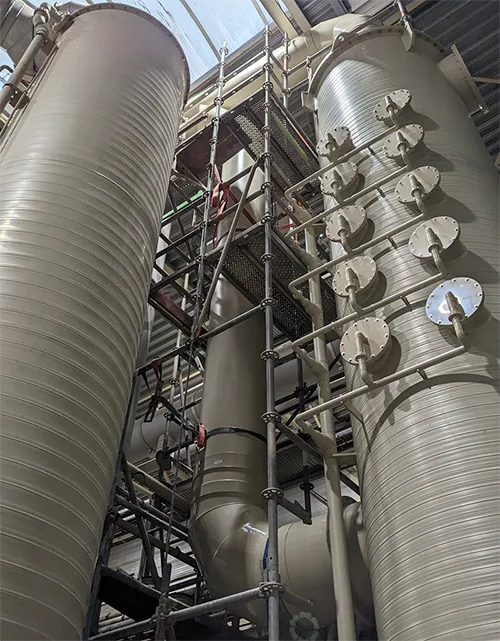
Gasification does not deliver a ready-to-use gas. Raw syngas leaves the gasifier hot and carries tar, dust, ammonia, hydrogen sulphide and hydrogen chloride. Before it can feed an engine, a methanation step or a synthesis catalyst, those contaminants have to come out. That is why gas cleaning is one of the subsidised steps in the chain.
It is also the step Lechler supplies. Our multi-stage wet scrubbers cool the hot gas, remove tar with an organic scrubbing liquid and absorb ammonia, hydrogen sulphide and hydrogen chloride in chemical stages. How this works is described in Biocarbon Is Scaling Up. So Is Its Process Gas. and on our page about syngas purification.
Planning a gasification project? Bring your gas composition, or the questions you still have about it, and we will outline which scrubbing stages your process needs. Contact our scrubber specialists.
Source: DEI+: Vergassing van reststromen, Netherlands Enterprise Agency (RVO), consulted on 1 October 2026.