
Process Technology · Gas Scrubbers
Stricter permits do not automatically mean a new scrubber. In many installations, targeted changes to the spray system, the liquid side or the internals close the gap.
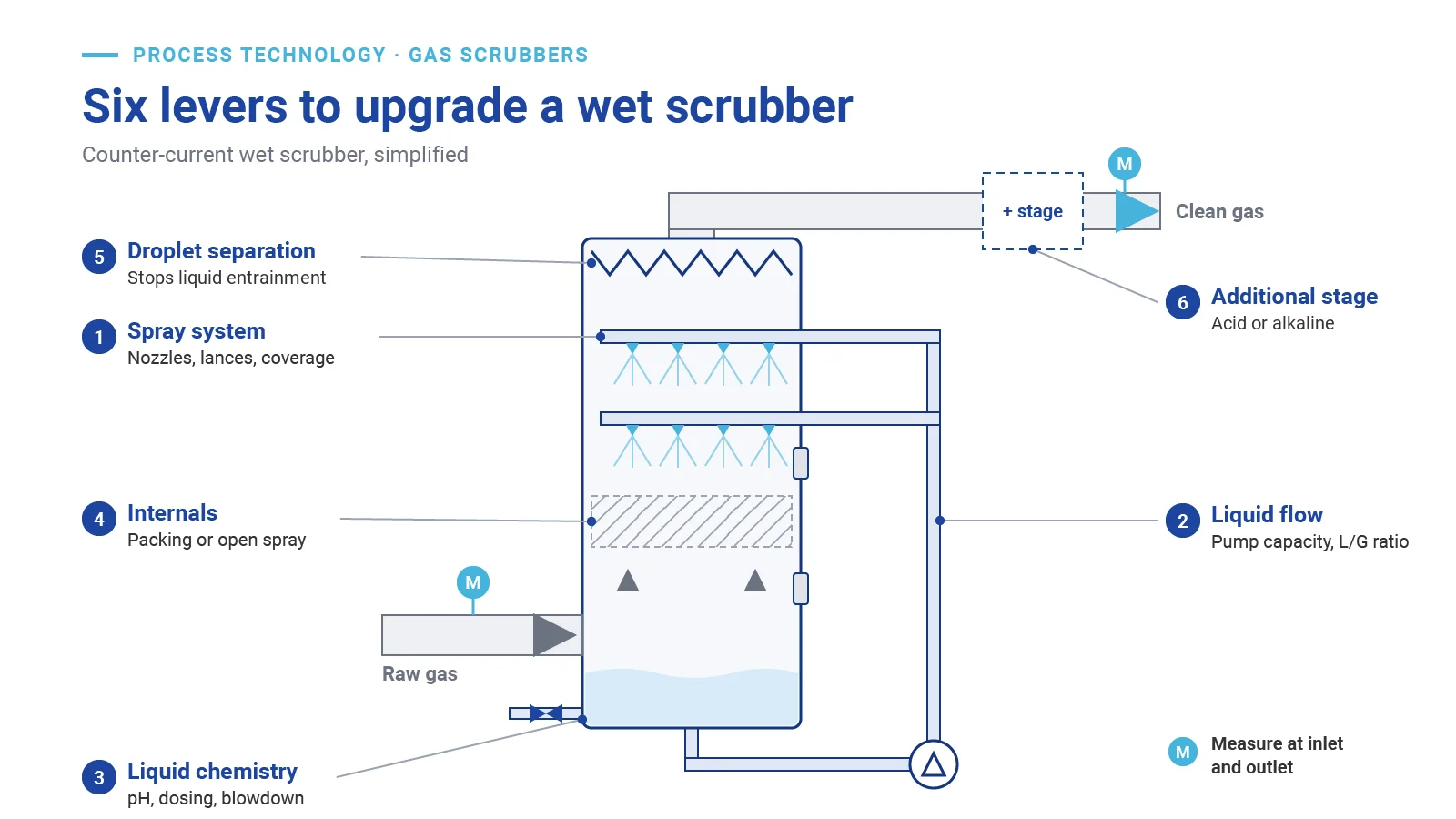
Many wet scrubbers in operation today were designed for emission limits that applied ten or twenty years ago. New BAT conclusions and the revised Industrial Emissions Directive push permits towards the strict end of the emission ranges. For operators, the obvious question is whether the existing scrubber can get there, or whether it has to be replaced.
A scrubber that no longer meets its target has usually lost performance in a few specific places: worn or blocked nozzles, a drifting liquid chemistry, fouled internals or a droplet separator that lets liquid through. Each of these can be measured and corrected. This article describes six retrofit levers, the symptoms that point to each of them, and the criteria that show when replacement is the better investment.
01 Why existing scrubbers fall short
A wet scrubber rarely fails suddenly. Its performance erodes over years. Nozzles wear and deliver more liquid in coarser droplets, or block and leave gaps in the spray pattern. Packing collects deposits. pH probes drift. Production changes, and the gas flow or composition no longer matches the original design.
At the same time, the target moves. Sector BAT conclusions, such as the WGC BAT conclusions for the chemical industry, set emission ranges, and under IED 2.0 permits will be based on the strictest level an installation can achieve within those ranges.
The first question is not "new or old?" but "where is the performance being lost?" Only a measurement and an inspection answer that question.
02 Six retrofit levers
1. Spray system
Nozzle type, droplet size, spray angle and coverage determine the contact area between gas and liquid. Replacing worn nozzles or choosing a different nozzle type and spray layout restores or increases mass transfer.
2. Liquid flow and L/G ratio
More scrubbing liquid per cubic metre of gas means more absorption capacity. A larger or speed-controlled recirculation pump lets the liquid flow follow the actual gas load. Because nozzle flow and droplet size depend on pressure, any turndown has to stay within the working range of the nozzles, or come from switching spray levels on and off.
3. Liquid chemistry
Absorption depends on pH, concentration and temperature. Reliable pH measurement, controlled reagent dosing and blowdown based on conductivity or density keep the chemistry in its optimum range.
4. Internals
Fouled packing raises the pressure drop and creates channels where gas bypasses the liquid. Cleaning restores it for a while; conversion to an open spray design removes the cause in fouling service.
5. Droplet separation
Droplets that leave with the clean gas carry dissolved salts and acids into the stack, where they are measured as dust or as the pollutant itself. An upgraded droplet separator stops this liquid entrainment.
6. Additional stage
When one chemistry cannot handle the full gas composition, a second stage adds the missing one: an acid stage for ammonia or an alkaline stage for acid gases. Hot or dusty gas needs a quench, and that always goes in front of the scrubber: it cools and saturates the gas and catches coarse dust before the gas reaches the spray zone.
03 From symptom to measure
Operating data usually points to the lever that needs attention. The table links common symptoms to their likely causes.
| Symptom | Likely cause | Retrofit measure |
|---|---|---|
| Outlet values rising over the years | Worn or blocked nozzles, pH drift, saturated liquid | Nozzle inspection and replacement, pH calibration, blowdown control |
| Increasing pressure drop | Fouled packing or droplet separator | Cleaning, or conversion to open spray |
| Dust or salt readings at the stack | Liquid entrainment or aerosol formation | Droplet separator upgrade, separation of incompatible streams |
| Exceedances only at peak load | Liquid flow sized on average load, no load following | Speed-controlled pump or switchable spray levels, control on measured inlet concentration |
| High chemical consumption | Unstable pH control, overdosing | Improved dosing control, analyser-based setpoints |
| High water consumption | Blowdown on a fixed schedule | Blowdown controlled on conductivity, density or measured performance |
04 When replacement is the better choice
Upgrade makes sense when
- The vessel and materials are in good condition
- Gas flow and composition are close to the original design
- The gap to the target can be traced to specific components
- There is room for an extra stage or a larger separator
Replacement makes sense when
- Corrosion or material degradation affects the vessel itself
- Gas flow has grown far beyond the design capacity
- The gas chemistry has changed fundamentally
- The required improvement exceeds what the vessel geometry allows
The decision is rarely black and white. A partial replacement, for example new internals and a new spray system in an existing vessel, or a new polishing stage downstream of the existing scrubber, often combines the advantages of both.
05 How a retrofit project runs
Measure
Simultaneous measurement at inlet and outlet shows the actual removal efficiency and the load the scrubber has to handle, peaks included. See Simultaneous Scrubber Testing with Analysers.
Inspect
Through the manholes, the nozzles, internals and droplet separator are inspected. Liquid samples and operating data complete the picture.
Calculate
The process design is recalculated for the measured conditions: liquid flow, droplet size, contact time and chemistry. This shows which levers close the gap and by how much.
Implement
Components are prepared in advance so the work fits within a planned shutdown. Spray lances, nozzles and separators can usually be replaced through existing openings.
Verify
A second measurement at inlet and outlet proves the result. If the analysers stay in place, they keep monitoring performance and can control the scrubber on real data.
06 Where Lechler comes in
Lechler combines more than a century of spray nozzle development with the design and construction of custom wet scrubbers. That combination matters in a retrofit: the spray system is often the lever with the largest effect, and it is where nozzle know-how makes the difference. Read more about droplet engineering in Precision in Every Drop. Lechler Process Technology also carries out the measurements before and after, so the improvement is demonstrated, not assumed.
Frequently asked questions
Can a scrubber from another manufacturer be upgraded?
In principle, yes. What matters is the condition of the vessel and the available documentation. A measurement and an inspection show what is possible.
Can a retrofit reach the strict end of a BAT-AEL range?
That depends on the starting point and on how much the vessel geometry allows. Recalculating the process design for the measured conditions shows in advance which values are realistic.
How much downtime does a retrofit need?
Most measures, such as new nozzles, spray lances or a droplet separator, are prepared in advance and installed during a planned shutdown. Adding a stage takes more preparation but can often be built alongside the running installation and connected during a shutdown.
Does a retrofit affect the permit?
A change to the gas treatment may have to be reported to the competent authority, depending on national rules and on the permit. Discuss this early; demonstrably lower emissions usually support the permit process.
Why convert a packed scrubber to open spray?
In gases with dust, tar or salts, packing fouls and the pressure drop rises. An open spray scrubber has no packing in the gas path, so there is nothing to block, while the spray system provides the contact area. See Open Spray Scrubbers.