
Process Technology · Regulation
The BAT conclusions for waste gas treatment in the chemical sector set the emission levels that permits must reflect from 12 December 2026. What they require, and how wet scrubbing meets them.
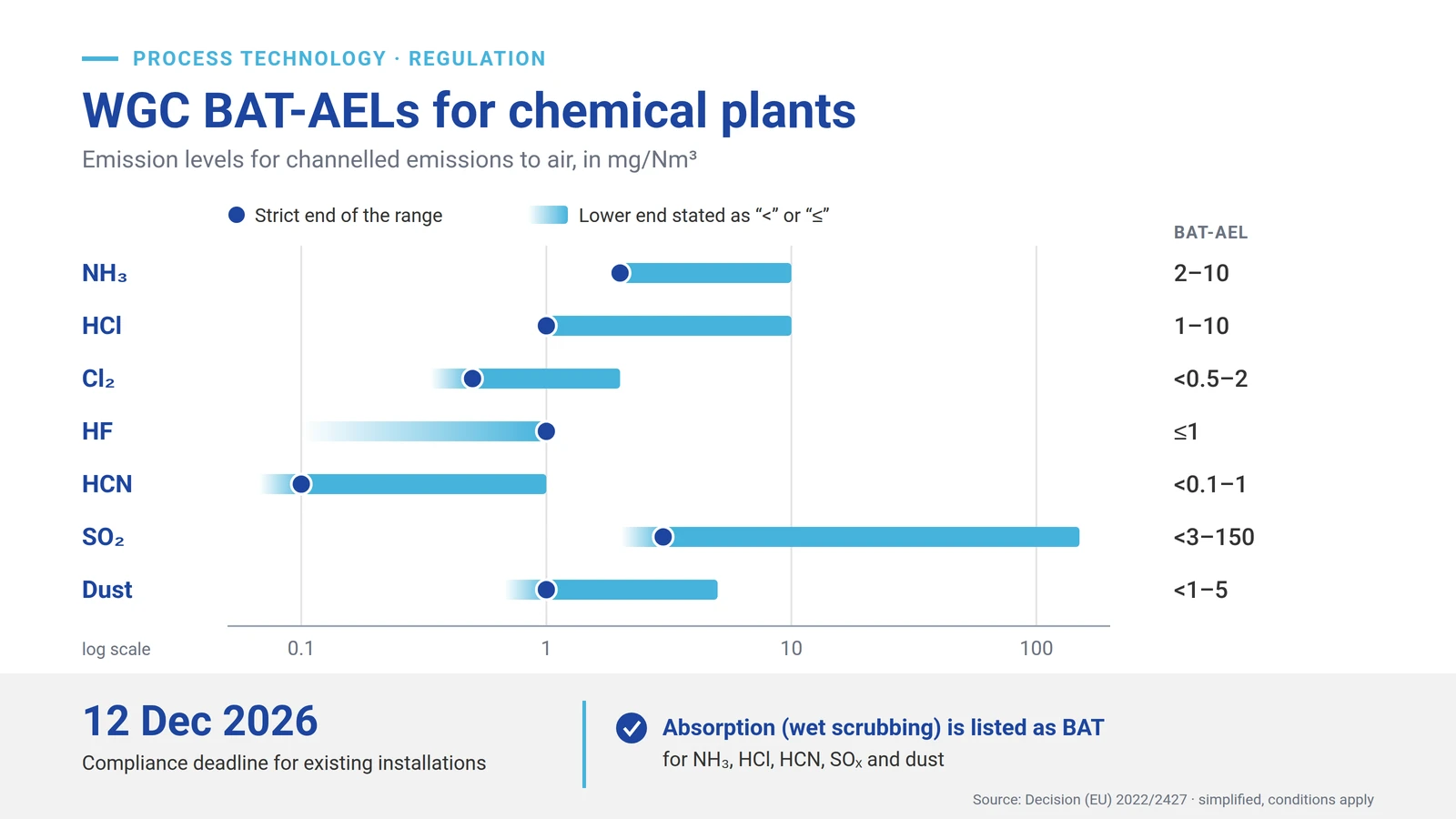
In December 2022 the European Commission published the BAT conclusions for common waste gas management and treatment systems in the chemical sector, known as the WGC BAT conclusions. Chemical installations covered by the Industrial Emissions Directive have four years to bring their permits and their emissions in line. That period ends on 12 December 2026.
The WGC BAT conclusions define BAT-associated emission levels (BAT-AELs) for channelled emissions to air, including ammonia, hydrogen chloride, chlorine, hydrogen fluoride, hydrogen cyanide, sulphur dioxide and dust. For all of these, absorption, in other words wet scrubbing, is listed as a best available technique. This article summarises the levels, the scrubber chemistry that goes with each pollutant, the pitfalls at the strict end of the ranges and the monitoring that comes with them.
01 What the WGC BAT conclusions cover
The WGC BAT conclusions (Commission Implementing Decision (EU) 2022/2427) apply to production processes in the chemical industry listed under points 4.1 to 4.6 of Annex I to the Industrial Emissions Directive, such as organic and inorganic chemicals, plant protection products and biocides, pharmaceuticals and explosives. They concern emissions to air, both channelled and diffuse.
Several activities are excluded because they have their own BAT conclusions: chlor-alkali production, a list of large-volume organic chemicals produced in continuous processes above 20 kt per year, a list of large-volume inorganic chemicals that includes ammonia, nitric acid, sulphuric acid and nitrogen-, phosphorus- or potassium-based fertilisers, combustion units other than process furnaces and heaters, and waste incineration.
Under the Industrial Emissions Directive, permits must be reconsidered and installations must comply within four years of the publication of new BAT conclusions. For the WGC BAT conclusions, published on 12 December 2022, that is 12 December 2026.
The revised directive (IED 2.0) adds a further requirement once transposed: the permit must set the strictest emission limit value the installation can achieve with BAT, based on an assessment of the entire BAT-AEL range. The lower end of each range in this article is therefore as relevant as the upper end. See our news item on the IED 2.0 infringement procedures.
02 BAT-AELs for inorganic compounds and dust
The table summarises the BAT-AELs for the pollutants that wet scrubbers typically treat in chemical plants, together with the minor-emission thresholds below which the BAT-AEL does not apply and the matching scrubber chemistry.
| Pollutant | BAT-AEL (mg/Nm³) | Not applicable below | Scrubber chemistry |
|---|---|---|---|
| Ammonia (NH₃) | 2–10 | approx. 50 g/h | Acid scrubbing, for example with sulphuric acid |
| Hydrogen chloride (HCl) | 1–10 | approx. 30 g/h | Water or alkaline scrubbing |
| Chlorine (Cl₂) | < 0.5–2 | approx. 5 g/h | Alkaline scrubbing, often with a reducing agent |
| Hydrogen fluoride (HF) | ≤ 1 | approx. 5 g/h | Water or alkaline scrubbing |
| Hydrogen cyanide (HCN) | < 0.1–1 | approx. 5 g/h | Alkaline scrubbing, often combined with oxidation |
| Sulphur dioxide (SO₂) | < 3–150 | approx. 500 g/h | Alkaline scrubbing |
| Dust | < 1–5 | approx. 50 g/h, if the dust contains no CMR substances | Wet scrubbing with efficient droplet separation, or filtration |
The decision also sets BAT-AELs for organic compounds, for example total volatile organic carbon (TVOC) at < 1–20 mg/Nm³ and benzene at < 0.5–1 mg/Nm³. For most organic compounds, adsorption and thermal or catalytic oxidation are the main techniques. Wet scrubbing plays a role for water-soluble organics and as a pre-treatment stage.
03 Absorption is a best available technique
For ammonia, hydrogen chloride, hydrogen cyanide, sulphur oxides and dust, the decision lists absorption among the best available techniques. In practice this means a wet scrubber in which the waste gas is brought into intensive contact with a scrubbing liquid, chosen to match the chemistry of the pollutant.
Acid scrubber
Operates at low pH and binds alkaline components such as ammonia and amines. With sulphuric acid, ammonia is converted into ammonium sulphate.
Alkaline scrubber
Operates at high pH, usually with caustic soda, and neutralises acidic components. For chlorine a reducing agent is often added; for cyanide an oxidation step may follow.
Multi-stage scrubber
When a waste gas contains both acidic and alkaline components, an acid and an alkaline stage are placed in series. Each stage is controlled on its own pH, which keeps both chemistries efficient.
04 Pitfalls at the strict end of the range
Reaching the upper end of a BAT-AEL range is usually a matter of correct design. Reaching the lower end requires attention to effects that hardly matter at higher concentrations.
Ammonia and hydrogen chloride in the same gas stream can form ammonium chloride aerosol. These fine particles pass a conventional scrubber largely untouched. Separating the streams or treating them in staged scrubbing prevents the problem.
Droplets of scrubbing liquid that leave with the clean gas carry dissolved salts and acids. They show up in the measurement as dust or HCl. An effective droplet separator is part of meeting the BAT-AEL.
Batch processes produce peaks that a scrubber sized on the average load cannot absorb. Liquid flow, pH and blowdown must follow the actual load, not a fixed setting.
Close to 1 mg/Nm³, measurement uncertainty becomes significant. Sampling location, heated sample lines and the right analyser determine whether the result is reliable.
05 Monitoring requirements
The WGC BAT conclusions also specify how often emissions must be monitored. A selection for the pollutants in this article:
| Pollutant | Minimum monitoring frequency |
|---|---|
| HCl, Cl₂, HF, HCN | Once every year (HCl to EN 1911) |
| SO₂ | Continuous at a mass flow of 2.5 kg/h or more, otherwise once every six months |
| Dust | Continuous at a mass flow of 3 kg/h or more, otherwise once every year |
For operators who want more than the minimum, measuring the scrubber inlet and outlet at the same time gives the actual removal efficiency and allows the scrubber to be controlled on real performance. See Simultaneous Scrubber Testing with Analysers.
06 What to do before 12 December 2026
Check which BAT-AELs apply
List the pollutants per emission point and compare their mass flows with the minor-emission thresholds. Only the emission points above the threshold fall under the BAT-AEL.
Measure the actual emissions
Use measured values, not permit values or design data. An emission survey shows the real concentrations, peaks included. See Measuring an Unknown Emission.
Compare with the full range
Check where each emission point sits within the BAT-AEL range, including the strict end. That is where the permit discussion under IED 2.0 will start.
Close the gap
Often an existing scrubber can be upgraded with a different nozzle configuration, better pH and blowdown control, an additional stage or a more effective droplet separator. Where that is not enough, a new scrubber is designed around the measured gas.
Frequently asked questions
Do the WGC BAT conclusions apply to my installation?
They apply to chemical production processes under points 4.1 to 4.6 of Annex I to the Industrial Emissions Directive, unless the activity is covered by other BAT conclusions, such as chlor-alkali production, fertilisers and other listed large-volume organic or inorganic chemicals. Your competent authority can confirm which BAT conclusions apply to your permit.
Why is the deadline 12 December 2026?
The decision was published in the Official Journal on 12 December 2022. The Industrial Emissions Directive gives four years from publication to reconsider permits and bring installations into compliance.
Is there a BAT-AEL for hydrogen sulphide?
Not a general one. The WGC BAT conclusions set a BAT-AEL for H₂S only for the production of viscose (1–10 mg/Nm³). For other processes, limits for hydrogen sulphide can still be part of your permit through national rules or odour requirements.
Is wet scrubbing accepted as a best available technique?
Yes. Absorption is listed among the best available techniques for ammonia, hydrogen chloride, hydrogen cyanide, sulphur oxides and dust.
What if an installation cannot reach the BAT-AEL in time?
The Industrial Emissions Directive allows a competent authority to grant a derogation in specific cases, based on an assessment showing that the costs would be disproportionate to the environmental benefits. This is an exception with strict conditions. Upgrading the existing gas treatment is usually the faster route.
Source: Commission Implementing Decision (EU) 2022/2427 (WGC BAT conclusions) · Standards referenced: EN 1911 (HCl)