News · Regulation · 1 October 2026
None of the 27 Member States transposed IED 2.0 by the 1 July 2026 deadline. National rules are running late, but the direction for industrial operators is clear.
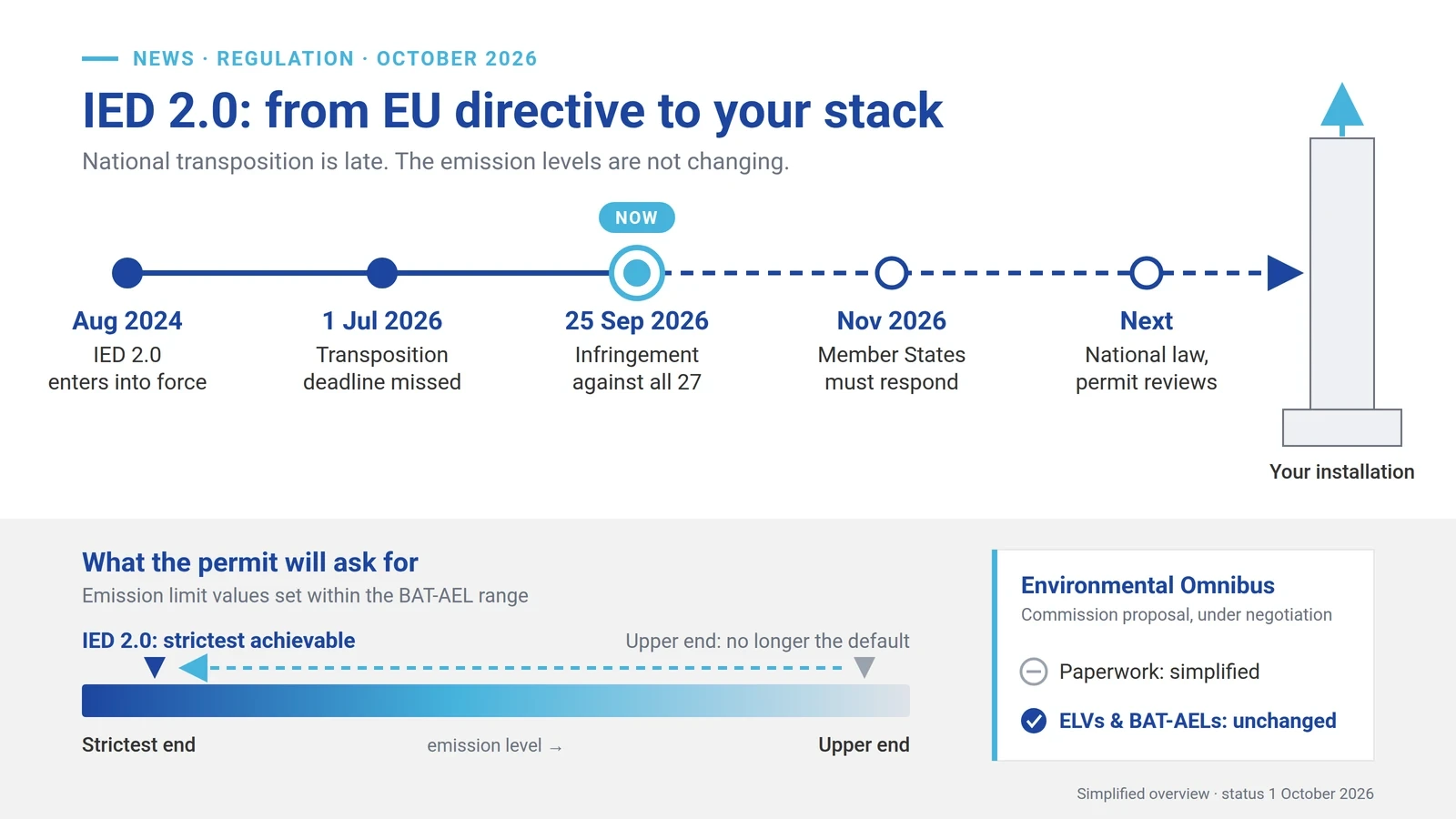
On 25 September 2026 the European Commission sent letters of formal notice to all 27 EU Member States for failing to transpose the revised Industrial Emissions Directive (Directive (EU) 2024/1785, known as IED 2.0) into national law. The deadline was 1 July 2026. The Member States now have two months to respond. If their answers are not satisfactory, the Commission can issue a reasoned opinion, the next formal step in the procedure.
01 What happened
IED 2.0 entered into force on 4 August 2024 and gave Member States two years to bring it into national law. By 1 July 2026 none of them had notified full transposition. The Commission has therefore opened infringement procedures against every Member State at once.
The procedure is aimed at the Member States, not at companies. Operators remain bound by their current permits and by national law as it stands today. The revised rules will reach installations through national legislation and permit reviews.
02 What IED 2.0 changes for operators
Once transposed, the revised directive tightens the way permits are written and enforced. The main changes for industrial installations:
Permits must set the strictest emission limit values achievable by applying best available techniques (BAT). The operator assesses the entire BAT-AEL range, including the feasibility of its strictest end. The upper end of the range is no longer the default.
For the most serious breaches, Member States must provide for fines with a maximum of at least 3% of the operator's annual turnover in the EU.
Citizens get the right to claim compensation for damage to their health caused by a breach of the rules.
Installations need an environmental management system with improvement objectives and periodic external audits.
The directive is extended to activities such as large battery factories, ore mining and a larger share of intensive livestock farms.
03 Simpler paperwork, same emission levels
In December 2025 the Commission published its Environmental Omnibus, a package to reduce administrative burden. It proposes to simplify parts of IED 2.0 before they take full effect. The proposal is still being negotiated by the Council and the European Parliament.
Proposed to be simplified
- Environmental management system at company level instead of per installation
- Chemical inventories removed
- Indicative transformation plans removed
- Longer deadlines for certain new provisions
Not touched by the proposal
- Emission limit values
- BAT-associated emission levels (BAT-AELs)
- The obligation to bring permits in line with new BAT conclusions
For operators, this means the administrative side of IED 2.0 may become lighter, while the emission levels that installations must meet stay where they are. New sector BAT conclusions continue to apply on their own timetable: permits must be brought in line within four years of publication. For the chemical sector, the BAT conclusions for common waste gas management and treatment (WGC) reach that point in December 2026.
04 What operators can do now
The delay in national legislation gives operators time. These four steps make good use of it.
Measure the actual emissions
Permit values describe what is allowed, not what the installation emits. An emission survey with heated sampling and FTIR analysis shows the real composition and load. See Measuring an Unknown Emission.
Compare with the full BAT-AEL range
Check the measured values against the BAT conclusions for your sector, including the strictest end of the range. That is where the permit discussion will start.
Assess the margin of existing abatement
An existing scrubber can often reach lower outlet values with targeted changes, such as a different nozzle configuration, better liquid management or an additional absorption stage. That is usually faster and cheaper than replacement.
Make performance demonstrable
Measuring at the scrubber inlet and outlet at the same time shows the actual removal efficiency, both to the operator and to the competent authority. See Simultaneous Scrubber Testing with Analysers.
05 How Lechler can support
Lechler Process Technology carries out emission surveys, engineers custom wet gas scrubbers and upgrades existing installations. Because we combine scrubber design with analyser know-how, we can measure where an installation stands today, show what it takes to reach the strict end of the BAT-AEL range, and prove the result after commissioning. Contact our scrubber specialists to discuss your installation.
Frequently asked questions
Does the infringement procedure mean IED 2.0 is postponed?
No. The directive has been in force since 4 August 2024 and Member States are obliged to transpose it. The infringement procedure is the Commission's instrument to make sure they do.
Can my company be fined under IED 2.0 today?
Operators are bound by their current permits and the national law that applies today. The new penalty regime applies once a Member State has transposed it into national law.
When will the new rules affect my installation?
Through national legislation and through the review of your permit, for example when new BAT conclusions for your sector are published. Your competent authority can tell you when a review is planned.
Will the Environmental Omnibus relax emission limits?
The Commission's proposal simplifies administrative requirements such as the environmental management system and removes chemical inventories and indicative transformation plans. It does not propose changes to emission limit values or BAT-AELs. The proposal is still under negotiation.
Sources: Directive (EU) 2024/1785 (EUR-Lex) · Eunews, 25 September 2026 · WGC BAT conclusions, Decision (EU) 2022/2427