News · Regulation · October 2026
By then, chemical installations must meet the emission levels of the BAT conclusions for waste gas treatment.
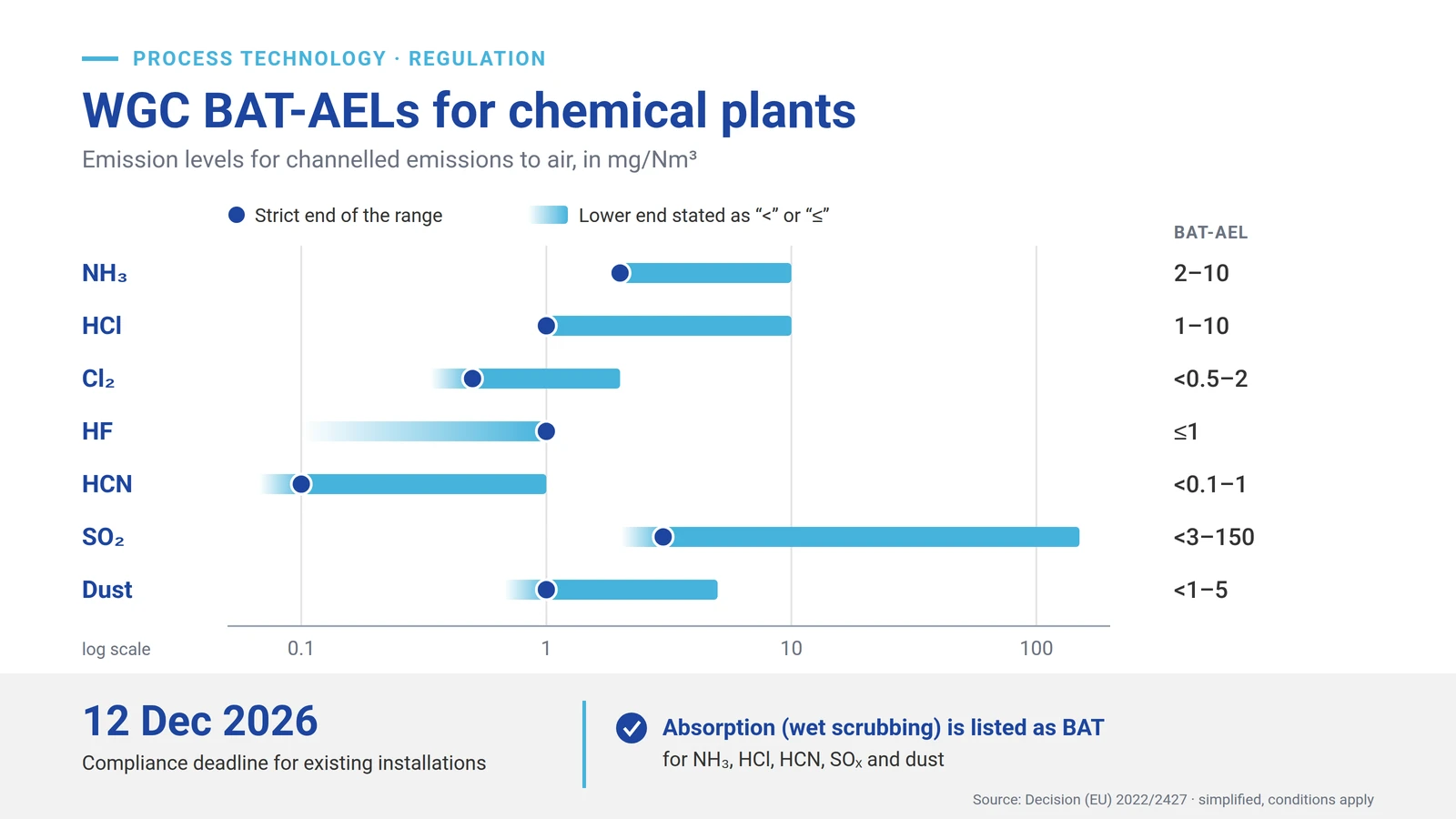
On 12 December 2026, the four-year transition period for the WGC BAT conclusions (Decision (EU) 2022/2427) ends. From that date, permits of chemical installations under the Industrial Emissions Directive must reflect the BAT-associated emission levels for channelled emissions to air, and installations must comply with them.
What applies
The WGC BAT conclusions cover the production of organic and inorganic chemicals, plant protection products, pharmaceuticals and explosives, unless an activity has its own BAT conclusions. They set emission levels for, among others, ammonia, hydrogen chloride, chlorine, hydrogen fluoride, hydrogen cyanide, sulphur dioxide, dust and organic compounds. For the inorganic pollutants and dust, absorption, in other words wet scrubbing, is listed as a best available technique.
Under the revised Industrial Emissions Directive, permits will also have to be based on the strictest level an installation can achieve within each range. Member States are still transposing that directive; see our news item on the IED 2.0 infringement procedures.
An overview of all relevant emission levels, the matching scrubber chemistry and the pitfalls at the strict end of the ranges is in our Knowledge article WGC BAT Conclusions: Emission Levels for Ammonia, HCl, SO₂ and Dust.
Where to start
Measure what your installation actually emits, compare it with the full BAT-AEL range and check whether the existing gas treatment can close the gap. Lechler Process Technology carries out emission surveys, upgrades existing scrubbers and designs new ones around the measured gas. Contact our scrubber specialists.