
Operation & Maintenance · Winter
What freezes in a wet gas scrubber, what breaks when it does, and what to check before winter, during a standstill and at restart.
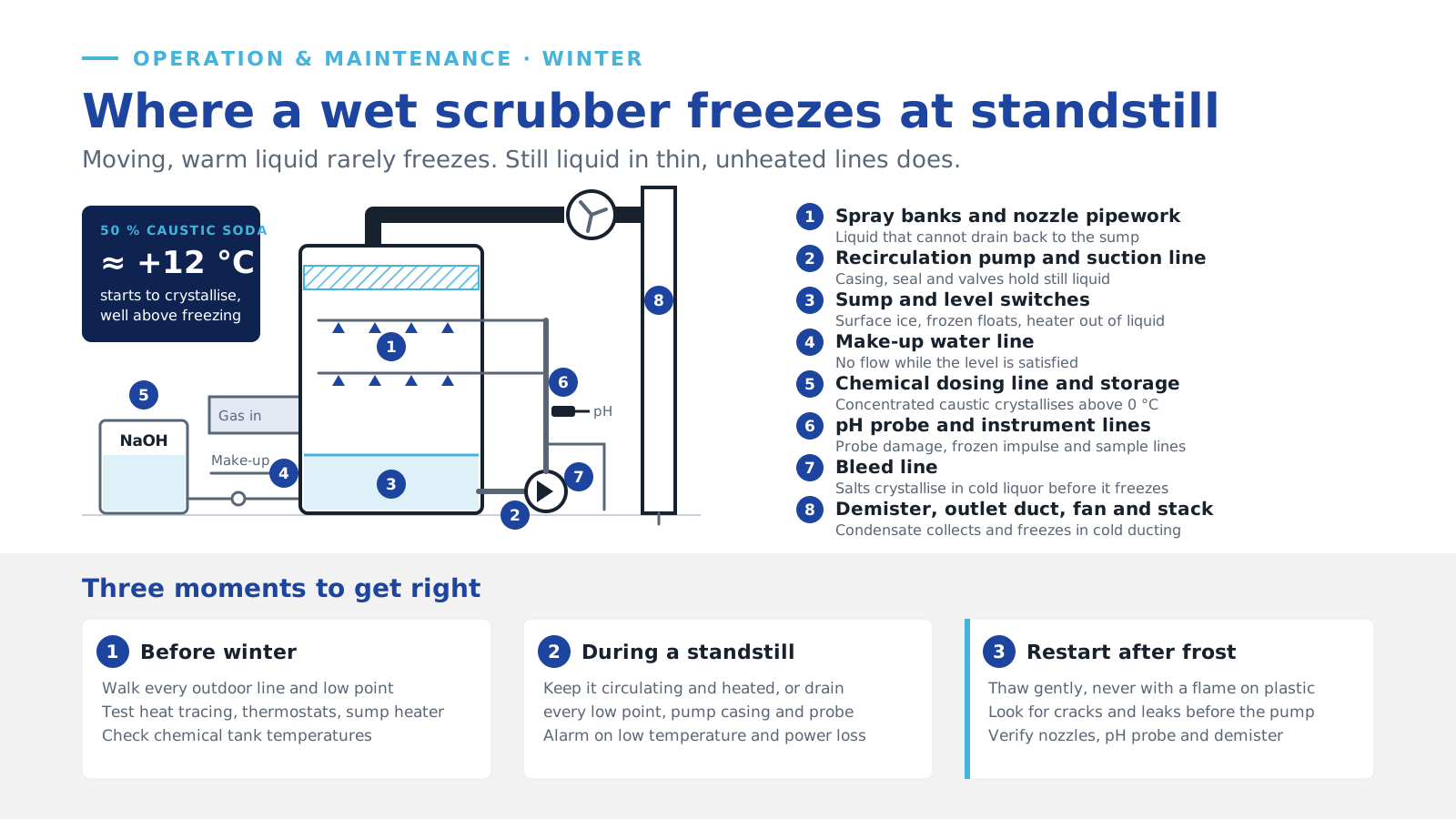
A wet gas scrubber that is running rarely freezes: the liquid moves, the process gas often brings heat, and the sump is a large volume that cools slowly. The damage happens when it stops. A weekend shutdown, the Christmas break, a fan trip on a cold night or a power failure is enough for still liquid in an outdoor line to turn to ice, and the scrubber only reveals it at restart.
Freezing damages a scrubber in two ways: water expands as it turns to ice and cracks pump casings, valves, pipework and instruments, and ice or crystallised chemicals block lines that look perfectly normal from the outside. This article goes through the eight points where an open spray scrubber is most exposed, explains why concentrated caustic soda causes trouble long before the thermometer reaches zero, and gives a practical checklist for three moments: before winter, during a standstill and at the restart after a frost period.
01 Why a standstill is the risk, not the frost itself
In normal operation, frost is rarely the problem. The recirculation pump keeps the scrubbing liquid moving, the extracted gas is often warmer than the outside air, and the pump itself adds a little heat. What matters is what happens in the hours after the scrubber stops. Liquid in a thin pipe has little heat to lose and loses it quickly, especially outdoors and in wind. The sump, with a large volume of liquid, cools far more slowly.
When water freezes, its volume increases by about 9 per cent. In a closed section of pipe, a pump casing or a valve body, that expansion has nowhere to go. The result is a cracked casing, a split pipe, a broken valve or a damaged instrument. The second effect is less visible: ice, or crystals from a concentrated chemical, blocks a line without any visible damage. The scrubber then starts without make-up water, without dosing or with half its nozzles blocked, and nobody notices until the emission or the pH drifts.
The most dangerous case is the unplanned one: a power failure on a frost night. The pump stops, but so do the heat tracing and the sump heater. A scrubber that is protected only by electrical heating is unprotected when the power is gone, so an alarm on power loss and low temperature belongs to winter preparation.
02 Eight places where an open spray scrubber freezes
Lechler builds open spray scrubbers: spray banks in an open vessel, a mist eliminator at the top and a sump at the bottom, without packing. That design has few internals that hold liquid, which helps in winter. The exposed points are mainly outside the vessel, in the lines and equipment around it. The numbers match the drawing above.
- 1
- Spray banks and nozzle pipework. The headers inside the vessel largely drain back through the nozzles when the pump stops. The risk is in the external riser and any section that cannot drain: behind a non-return valve, in a horizontal run without a fall, or in a low point. A line that freezes there can crack, and loose ice or scale can block nozzles at restart.
- 2
- Recirculation pump and suction line. The pump casing, the mechanical seal and the valves on either side hold liquid that does not drain by itself. A frozen casing can crack; starting a pump with ice in it can damage the impeller and the seal.
- 3
- Sump and level switches. A large sump will not freeze solid overnight, but surface ice can form and floats or level switches can freeze in position. A sump heater must stay covered by liquid; if the level drops below it, it heats air and can overheat a plastic vessel wall.
- 4
- Make-up water line. Often the first line to freeze, even during operation: when the sump level is satisfied, the solenoid or float valve closes and the water in the line stands still. Outdoor sections, meters and valves need heat tracing or must be drained.
- 5
- Chemical dosing line and storage. Concentrated caustic soda crystallises well above 0 °C (see section 03). Dosing lines are thin and carry small flows, so they cool quickly; an outdoor IBC or tank without heating can crystallise on a cool night in autumn.
- 6
- pH probe and instrument lines. pH and redox probes contain a liquid or gel electrolyte; manufacturers specify a minimum storage temperature and warn against frost damage. Impulse lines to pressure transmitters and sample lines to analysers are small, still volumes that freeze early.
- 7
- Bleed line. The bleed carries the most concentrated liquor in the system. In some processes salts crystallise out as it cools, long before it freezes (see section 03). A bleed line that stands still in the cold can block with crystals rather than ice.
- 8
- Demister, outlet duct, fan and stack. The gas leaving a wet scrubber is close to saturation with water vapour. In a cold outdoor duct or stack part of that vapour condenses, and the condensate runs to the low points: the fan housing, the stack drain and horizontal duct sections. If those drains freeze, water collects, and ice can form at the stack outlet. At standstill a wet demister can also freeze if cold air flows through it.
Outdoor structures need attention as well: platforms, ladders and walkways can ice over, and ice that forms at the top of a stack can fall. Include access routes in the winter inspection, not only the process equipment.
03 Chemicals that freeze above zero
Water freezes at 0 °C; scrubbing chemicals do not follow that rule. The best-known example is caustic soda. Delivered at 50 per cent, it starts to crystallise at about 12 °C (54 °F, according to the OxyChem Caustic Soda Handbook). A dosing line in an unheated outdoor area can therefore block on a mild autumn night, weeks before the first frost.
Diluting does not automatically help. The freezing curve of caustic soda is irregular because the solution forms several hydrates. Supplier data put a 30 to 33 per cent solution at roughly +1 to +8 °C, hardly better than many winter nights, and around 40 per cent the crystallisation point is even higher than at 50 per cent. The lowest freezing point lies at about 18 to 20 per cent. If you change concentration for the winter, choose it from your supplier's freezing curve, not by intuition, and remember that the dosing pump setting and the dosing control have to follow.
| Chemical | Concentration | Starts to freeze or crystallise | What it means in winter |
|---|---|---|---|
| Caustic soda (NaOH) | 50 % | about +12 °C | Heated and insulated storage and dosing lines, also outside the frost season |
| 30–33 % | roughly +1 to +8 °C | Still needs protection on cold nights | |
| about 18–20 % | roughly −28 °C (the lowest point) | Low freezing point, but a larger volume to store and dose | |
| Sulphuric acid (H2SO4) | 93–98 % | varies strongly with concentration | Some grades stay liquid far below zero, others freeze around 0 °C; pure acid melts at about 10 °C. Check the supplier's data for your grade |
| Sodium hypochlorite (NaOCl) | 12–15 % | well below 0 °C | Supplier data sheets give values in the region of −15 to −25 °C; do not overheat, warmth speeds up decomposition |
The scrubbing liquor itself can behave in the same way. In a caustic stage that absorbs SO2, the bleed contains sodium sulphate, and the solubility of sodium sulphate in water drops by more than a factor of ten between about 32 °C and 0 °C. A bleed that is close to saturation in the warm sump can deposit crystals in a cold line. Whether that applies to your scrubber depends on the process and the bleed setting; it is worth asking before the first cold spell rather than after a blocked line.
04 Plastics in the cold
Most wet scrubbers are built in plastics: polypropylene (PP), PVDF or glass-fibre reinforced plastic (GRP), sometimes combined with stainless steel. These materials resist the chemicals well, but cold changes their behaviour. Polypropylene becomes less tough as the temperature drops: GF Piping Systems, for example, rates its PP-H piping system from 0 °C upwards, and its PVDF system from −20 °C. A frozen PP line is therefore vulnerable twice: the ice pushes on the wall from inside, and the wall is less able to absorb a blow.
- Do not knock ice off plastic pipework, valves or the vessel. A blow that would leave no mark in summer can crack cold PP.
- Thaw gently. Use the heat tracing, warm air or warm water; never an open flame or a steam lance on plastic pipework, which can exceed the temperature limit of the material locally.
- Expect movement. Plastics expand and contract much more with temperature than steel. Flange joints and supports that were tight in summer can leak or shift after a cold period, so check them at the restart.
- Steel is not immune. A stainless steel pipe full of water bursts just as easily when it freezes; the material does not change the physics of ice.
The ratings above apply to piping systems under pressure; a vessel or duct that is empty and cold is a different load case. If your scrubber stands outdoors in a region with long periods of severe frost, ask the supplier what the design temperature of the equipment is.
05 Before winter: the checklist
The best moment for a frost check is autumn, while everything is still running and a defect can be repaired without pressure. Walk the installation with the drawing in hand.
List every line that can stand still in the cold
Outdoor and unheated sections, low points, dead legs, sections behind non-return valves, the make-up water line, dosing lines, bleed, drains, impulse and sample lines. Check that each low point has a drain valve that can be reached and opened.
Test the heat tracing and the insulation
Switch the heat tracing on and check that every circuit actually warms up, including the thermostats and any alarm contacts. Insulation without heat tracing only delays freezing during a standstill; it does not prevent it. Wet or damaged insulation loses most of its value, so repair open seams and replace soaked sections.
Check the sump heater and the level protection
Where a sump heater is fitted, check that it works and that it is interlocked with a low level, so it cannot run dry. Check that floats and level switches move freely.
Protect the chemicals
Measure the temperature of the caustic soda in storage and in the dosing line, check the tank heating and insulation, and agree with your supplier on the delivery concentration for the winter if you want to change it.
Set the alarms
A low-temperature alarm in the sump and in the most exposed line, an alarm on power loss and on a failed heat-tracing circuit, and a clear agreement on who responds outside working hours. With remote support these alarms reach someone who can act, not only a display in an empty plant.
Decide the standstill strategy in advance
For each planned stop, from a weekend to a two-week shutdown, decide beforehand whether the scrubber keeps circulating or is drained down. Write it into the shutdown procedure, so the decision is not left to whoever closes the plant on the last evening.
06 During a standstill: keep it circulating or drain it down
There are two sound ways to get a scrubber through a frost period while the process is stopped. Both work; the mistake is a half-way state, such as a stopped pump with full lines and no heating.
Keep circulating, with heat
- The pump keeps the liquid moving at reduced flow; heat tracing and the sump heater stay on
- The chemistry stays in place and the restart is quick
- Moving liquid still loses heat: in a long or severe frost period, circulation alone is not enough without heat input
- Depends entirely on power and on the alarms: a trip at night must be noticed
Drain down
- Nothing left that can freeze, provided every low point is really empty
- Drain the pump casing, the riser, the make-up line, dosing lines and the bleed; open the drains, do not only stop the pump
- Remove pH and redox probes and store them as the manufacturer specifies, frost-free and wet
- A longer restart: refilling, dosing up to the right pH and checking for leaks
Remember the gas side as well. With the fan stopped, cold outside air can sink into the stack and through the scrubber, cooling a wet demister and the upper part of the vessel. Where a damper is fitted, close it during a long standstill, and check the stack and fan drains before the restart.
07 Restart after a frost period
A scrubber that has stood still in frost should not simply be switched on. A pump that starts against an ice plug or with ice in its casing can be damaged within seconds, and a crack only shows when the system is under pressure again.
Make sure everything has thawed
Switch on the heat tracing in good time and check the exposed lines by hand or with a surface thermometer. Thaw blocked sections gently; never with a flame or steam on plastic.
Inspect before you pressurise
Look for cracks in pump casings, valve bodies and fittings, for split pipe sections and for bulging or wet insulation. Use the inspection hatches to check the sump and the spray banks.
Refill and start slowly
Fill or top up the sump, vent the pump and start at reduced flow where possible. Walk the lines while the pressure builds and check flange joints for leaks.
Verify the functions, not just the pump
Check the spray pattern and pressure per bank (a blocked nozzle shows as a change in pressure and flow), the make-up water and dosing flows, the pH reading against a reference, and the pressure drop over the demister. Then confirm the emission with the measurement you normally rely on; see what to monitor on a wet scrubber.
08 When the design is the problem
Some frost problems come back every winter because of how the installation was built: a make-up line along an outside wall, a dosing tank in an open yard, a pump in an unheated corner, a bleed without a fall. Heat tracing can solve a lot, but sometimes rerouting a line, adding a drain point, moving the dosing station indoors or adding a pump housing is the lasting solution. If you are considering wider changes to an existing scrubber, our article Upgrade or Replace? describes how we assess an existing installation.
Not sure where your weak points are? Our engineers are happy to look at it with you: the exposed lines, the heat tracing, the dosing and the alarms, and a standstill and restart procedure that fits your plant. Contact us to discuss your installation.
Frequently asked questions
Can a scrubber freeze while it is running?
The main circuit rarely does, because the liquid moves and the gas is usually warmer than the outside air. Lines without flow can freeze during operation, however: the make-up water line while the level is satisfied, a dosing line with a small or intermittent flow, impulse lines to instruments and condensate drains on the stack or fan.
At what temperature does caustic soda freeze?
It depends strongly on the concentration. A 50 per cent solution starts to crystallise at about 12 °C. Solutions of around 30 to 33 per cent do so at roughly +1 to +8 °C, and the lowest freezing point, roughly −28 °C, lies at about 18 to 20 per cent. Always check the freezing curve or data sheet of your own supplier.
Is insulation enough to protect a line?
Not during a standstill. Insulation slows down heat loss but does not add heat, so liquid that stands still in an insulated line freezes later, but it still freezes in a long cold period. Insulation is effective together with heat tracing, or on lines that keep flowing.
Should we drain the scrubber over the Christmas break?
That depends on the installation and on who is available. Keeping it circulating with heat tracing and a sump heater gives a quick restart but relies on power and on someone responding to alarms. Draining down is safe if every low point, the pump casing and the instrument lines are really empty. Decide it in advance and write it into the shutdown procedure.
How do we thaw a frozen plastic line?
Slowly, with the heat tracing, warm air or warm water. Do not use an open flame or a steam lance on PP or PVDF pipework, and do not knock the ice out: cold polypropylene cracks more easily than warm. After thawing, inspect the line for cracks before you put it under pressure.
Sources: OxyChem, Caustic Soda Handbook (handling liquid caustic soda, handling in cold weather) · Covestro, product information caustic soda 50 % (solidification points by concentration, typical values) · GF Piping Systems, specifications PROGEF Standard (PP-H) and SYGEF Standard (PVDF) · Endress+Hauser, technical information Orbisint CPS11 (storage temperature of pH electrodes) · supplier safety data sheets for sulphuric acid and sodium hypochlorite
't Woud 59, 3232 LN Brielle, The Netherlands · +31 181 419 419
Open spray scrubbers, spray nozzles and PLC control with remote support, from design to winter-proof operation. Part of the Lechler Group.