
Process Technology · Regulation
The BAT conclusions for ferrous metals processing set the emission levels that pickling lines, acid regeneration plants and galvanisers must meet from 4 November 2026. What they require, and how a wet scrubber with a demister gets there.
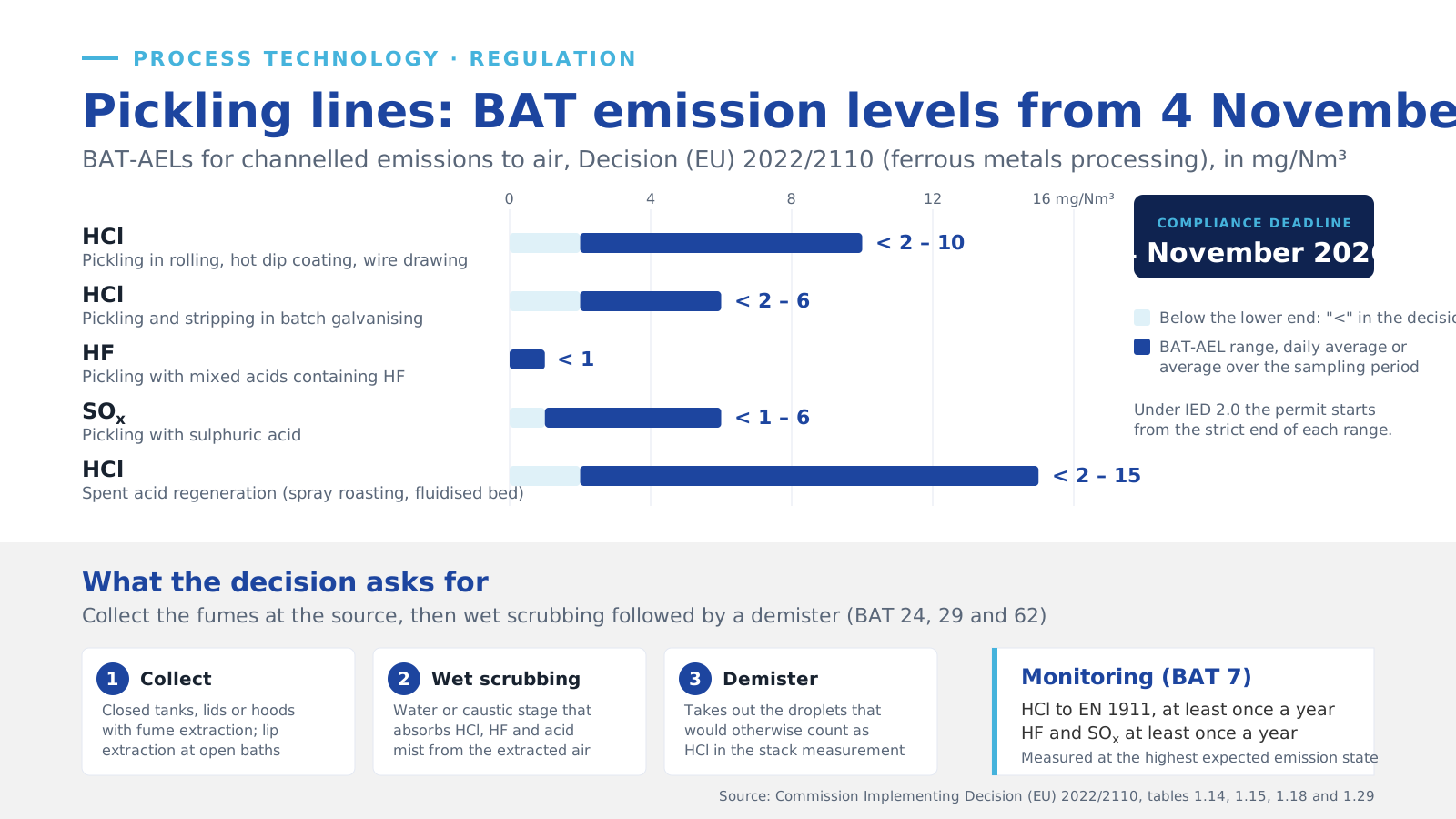
On 4 November 2022 the European Commission published the BAT conclusions for the ferrous metals processing industry, the FMP BAT conclusions. Hot rolling mills, cold rolling and wire drawing lines, hot dip coating lines and batch galvanising plants under the Industrial Emissions Directive have four years to bring their permits and their emissions in line. That period ends on 4 November 2026.
For pickling, the decision sets BAT-associated emission levels (BAT-AELs) for hydrogen chloride, hydrogen fluoride and sulphur oxides, and for the regeneration of spent acid it adds dust, SO₂ and NOx. The technique it names is the same in every case: collect the fumes at the source and treat them by wet scrubbing followed by a demister. This article summarises the levels per process, the scrubber chemistry behind each acid, the points that decide whether the strict end of a range is reachable, and the monitoring that comes with it.
01 Who the FMP BAT conclusions apply to
Commission Implementing Decision (EU) 2022/2110 covers three activities from Annex I to the Industrial Emissions Directive: hot rolling mills with a capacity above 20 tonnes of crude steel per hour, the application of protective fused metal coats with an input above 2 tonnes of crude steel per hour, which includes continuous hot dip coating and batch galvanising, and the surface treatment of ferrous metals in vats with a total volume above 30 m³ when carried out in cold rolling, wire drawing or batch galvanising. Cold rolling and wire drawing are also covered when they are directly associated with hot rolling or hot dip coating, and so is acid recovery that belongs to one of these activities.
Electroplating and electroless plating are not covered; they fall under the BAT conclusions for the surface treatment of metals and plastics. A galvaniser that pickles in open hydrochloric acid baths is covered, provided the plant passes one of the thresholds above.
Under Article 21 of the Industrial Emissions Directive, the competent authority must reconsider the permit and the installation must comply within four years of the publication of new BAT conclusions. The FMP BAT conclusions were published in the Official Journal on 4 November 2022, so the date is 4 November 2026.
The revised directive, IED 2.0, adds a further step once Member States have transposed it: the permit must set the strictest emission limit value the installation can achieve with BAT, based on an assessment of the entire BAT-AEL range. The lower end of each range in this article is therefore as relevant as the upper end. The Netherlands has not yet completed that transposition; see our news item on the IED 2.0 infringement procedures.
02 BAT-AELs for pickling and acid regeneration
The table lists the BAT-AELs for channelled emissions to air from the acid-related processes in the decision. Each value is a daily average or the average over the sampling period, for dry gas at 273.15 K and 101.3 kPa, without correction for oxygen.
| Process | Parameter | BAT-AEL (mg/Nm³) | Applies to |
|---|---|---|---|
| Pickling in hot rolling, cold rolling and hot dip coating (table 1.14) | HCl | < 2–10 | Pickling with hydrochloric acid |
| HF | < 1 | Pickling with acid mixtures containing hydrofluoric acid | |
| SOx | < 1–6 | Pickling with sulphuric acid | |
| Pickling in wire drawing (table 1.15) | HCl | < 2–10 | Pickling with hydrochloric acid |
| SOx | < 1–6 | Pickling with sulphuric acid | |
| Pickling with nitric acid in hot and cold rolling (table 1.16) | NOx | 10–200 | Nitric acid alone or in acid mixtures, typically high-alloy steel |
| Pickling and stripping in batch galvanising (table 1.29) | HCl | < 2–6 | Hydrochloric acid baths |
| Regeneration of spent hydrochloric acid by spray roasting or fluidised bed (table 1.18) | Dust / HCl / SO₂ / NOx | < 2–15 / < 2–15 / < 10 / 50–180 | Acid recovery plants |
| Recovery of mixed acid by spray roasting or evaporation (table 1.19) | HF / NOx / Dust | < 1 / 50–100 / < 2–10 | The NOx upper end may be up to 200 for spray roasting |
The decision also sets levels for the other emission points of these plants, such as NOx and dust from feedstock heating, dust from mechanical processing and dust and zinc from the galvanising kettle. Those are mostly combustion and filtration questions and are outside the scope of this article.
03 What the decision asks for: collect, scrub, demist
BAT 24 for pickling in rolling, coating and wire drawing, BAT 29 for acid recovery and BAT 62 for batch galvanising all follow the same pattern. First the fumes are collected: continuous pickling in closed tanks with limited openings for the strip or wire, batch pickling in tanks with lids or enclosing hoods, and in batch galvanising an enclosed pretreatment section or lateral and lip extraction at the edge of the tanks. Then the extracted air is treated by wet scrubbing followed by a demister.
Collect at the source
The closer the extraction is to the bath surface, the less air it takes to capture the fumes and the higher the concentration that reaches the scrubber. Lip extraction on an open bath moves a lot of air for the acid it collects. Note that the directive disregards dilution when assessing compliance: extra extraction air does not help with the BAT-AEL.
Wet scrubbing
The decision defines wet scrubbing as the removal of gaseous or particulate pollutants by mass transfer to a liquid, often water or an aqueous solution, with or without a chemical reaction. For hydrochloric acid fumes that means a water or caustic stage; for mixed acid recovery the decision itself notes that an alkali is added to remove traces of HF, and for nitric acid pickling that an oxidising agent such as hydrogen peroxide is added to reduce NOx.
Demister
A demister removes the entrained droplets from the gas before it leaves the stack. The decision lists it as part of the technique, not as an option, and for good reason: droplets of scrubbing liquid are the usual cause of an HCl reading that stays above the lower end of the range after the gas itself has been cleaned.
For existing batch galvanising plants, BAT 62 allows one alternative: operating open hydrochloric acid baths within a restricted temperature and concentration window, provided this gives at least an equivalent level of protection. The window is narrow (see the FAQ), and the bath temperature and acid concentration must be checked and recorded. For most plants, extraction plus a scrubber is the more robust route.
04 Scrubber chemistry per acid
Pickling fumes are a mixture of acid vapour, acid mist and water vapour from a warm bath. Which of these dominates depends on the acid, and so does the scrubber design.
Hydrochloric acid
HCl is very soluble in water, so a water stage already captures most of it. In a recirculating loop, however, the acid concentration in the liquid rises and with it the HCl vapour pressure above it, and the outlet creeps up. Either the liquid is bled and replenished continuously, or a caustic stage neutralises the acid to sodium chloride. Our pickling scrubbers use a caustic stage followed by a fresh-water stage, each with its own buffer.
Hydrofluoric acid
HF from mixed acid pickling of stainless steel is also soluble and is bound in an alkaline stage as fluoride. Two things differ from HCl: the BAT-AEL is a single value of below 1 mg/Nm³, and the scrubber bleed carries fluoride into the waste water, where the decision sets a BAT-AEL of 1–15 mg/l for indirect discharges. Fluoride precipitation downstream is part of the design.
Sulphuric acid
Sulphuric acid hardly evaporates; what leaves the bath is an acid mist. The decision counts that mist as SOx, together with any SO₂ and SO₃. Removing a mist is a droplet capture problem rather than an absorption problem: the spray zone collects the larger droplets, the demister the rest, and the fine fraction decides whether the strict end is reached.
Nitric acid
Nitric acid pickling of high-alloy steel releases nitrogen oxides. NO is poorly soluble, so a plain water or caustic scrubber removes little of it. The decision names wet scrubbing with an oxidising agent such as hydrogen peroxide, which converts the nitrogen oxides to nitric acid in the liquid; that acid can be returned to the pickling tanks.
All our pickling scrubbers are open spray scrubbers in polypropylene: spray banks, an intermediate separator between the stages and a final droplet separator, with no packing to foul. The extracted air enters through a rectifier so that the flow through the spray zone is laminar. See the reference scrubber for pickling baths and the industry pages for steel and surface treatment.
05 What decides the strict end of the range
Reaching 10 mg/Nm³ of HCl is a matter of correct design. Reaching below 2 mg/Nm³ requires attention to effects that hardly matter at higher concentrations.
Droplets of acidic scrubbing liquid that leave with the gas evaporate in the heated sampling probe and are measured as HCl. A demister that is sized for the actual gas velocity, and kept clean, is the difference between a reading of 1 and a reading of 5.
A water-only scrubber that recirculates without a sufficient bleed turns into a dilute acid scrubber. pH control on the caustic stage and a conductivity- or pH-controlled bleed on the water stage keep the driving force for absorption where it should be.
Air extracted from a bath at 60 to 80 °C is saturated with water vapour. In the scrubber it cools and the water condenses into the liquid, which raises the level and dilutes the chemistry. The buffer, the overflow and the dosing must be designed for that, not only for the acid load.
Batch pickling and batch galvanising produce peaks when a coil or a rack goes in and when the bath is topped up with fresh acid. The scrubber must follow the peak, which argues for pH-controlled dosing rather than a fixed chemical feed.
Close to 1 mg/Nm³ the measurement uncertainty of a periodic HCl measurement becomes a significant part of the result. Sampling position, heated lines and a clean reference method matter. See Meeting the Limit Is Not the Same as Proving It.
06 Monitoring requirements
BAT 7 sets the minimum monitoring frequency per process. For the acid-related emission points this is periodic measurement, at least once a year, carried out at the highest expected emission state under normal operating conditions.
| Parameter and process | Standard | Minimum frequency |
|---|---|---|
| HCl, pickling with hydrochloric acid (rolling, coating, wire drawing, batch galvanising) | EN 1911 | Once every year |
| HCl, open pickling baths in batch galvanising without extraction | No EN standard | Once every year, measured in the gas phase above the bath |
| HF, pickling with mixed acids | EN standard under development | Once every year |
| SOx, pickling with sulphuric acid | EN 14791 if continuous | Once every year |
| NOx, pickling with nitric acid | EN 14792 | Once every year |
| Dust, HCl, SO₂, NOx, acid regeneration | EN 13284-1 (dust), EN 1911 (HCl) | Once every year |
For operators who want to know rather than hope, measuring the scrubber inlet and outlet at the same time gives the actual removal efficiency and lets the scrubber be controlled on real performance. See Simultaneous Scrubber Testing with Analysers.
07 What to do before 4 November 2026
Check whether and where the decision applies
Compare the plant with the thresholds in section 01 and list the emission points: pickling tanks, rinsing, stripping, acid storage, acid regeneration. The competent authority will do the same when it reconsiders the permit.
Measure the actual emission
Use measured values at the highest expected emission state, not design data. An emission survey shows where each stack sits in the range, peaks included. See Measuring an Unknown Emission.
Check the collection first
A scrubber can only treat what reaches it. Open tanks without lids or hoods, and extraction that does not capture the fumes, are the first thing the decision looks at and the first thing to fix.
Close the gap
An existing scrubber can often be brought to the strict end with a better demister, pH-controlled dosing, a controlled bleed or an additional stage. Where that is not enough, a new scrubber is designed around the measured gas. See Upgrade or Replace?
Frequently asked questions
Does the decision apply to a batch galvanising plant?
Yes, if the plant applies protective fused metal coats with an input above 2 tonnes of crude steel per hour, or if its treatment vats for pickling, degreasing and fluxing exceed 30 m³ in total. Below both thresholds the plant is not an IED installation and the BAT conclusions do not apply directly, although national rules may still refer to them.
Why is the deadline 4 November 2026?
Decision (EU) 2022/2110 was adopted on 11 October 2022 and published in the Official Journal on 4 November 2022. The Industrial Emissions Directive gives four years from publication to reconsider permits and bring installations into compliance.
Can an open hydrochloric acid bath stay without extraction?
Only in existing batch galvanising plants, and only within the operating window of BAT 62: the bath temperature T in °C and the HCl concentration w in weight per cent must satisfy 4 < T < (80 − 4w) and 2 < w < (20 − T/4). At 15 per cent HCl, for example, the bath may not exceed 20 °C. The temperature is measured daily, the concentration at every acid top-up and at least weekly, and air movement over the bath is minimised. The plant must show that this gives at least the same protection as extraction with a scrubber.
Is wet scrubbing accepted as a best available technique?
Yes. Wet scrubbing followed by a demister is the waste gas treatment named in BAT 24 for pickling, BAT 29 for acid recovery and BAT 62 for batch galvanising. For nitric acid pickling, BAT 25 names wet scrubbing with an oxidising agent.
What happens to the scrubber bleed?
From a caustic stage the bleed is a salt solution; from a water stage it is dilute acid that can often be returned to the rinsing section of the line. Where it is discharged, the decision's waste water BAT-AELs apply, including fluoride at 1–15 mg/l for pickling with mixed acids containing HF.
What if an installation cannot reach the BAT-AEL in time?
The directive allows the competent authority to grant a derogation in specific cases, based on an assessment showing that the costs would be disproportionate to the environmental benefit. This is an exception with strict conditions. Upgrading the existing collection and scrubbing is usually the faster route.
Source: Commission Implementing Decision (EU) 2022/2110 (FMP BAT conclusions), Official Journal L 284 of 4 November 2022 · Standards referenced: EN 1911 (HCl), EN 14791 (SO₂), EN 14792 (NOx), EN 13284-1 (dust)
't Woud 59, 3232 LN Brielle, The Netherlands · +31 (0)181 419 419
Two-stage polypropylene scrubbers for pickling, anodising and galvanising lines, from emission survey to verified performance.