
Process Technology · Regulation
The BAT conclusions for slaughterhouses and animal by-products set the levels for odour, ammonia, hydrogen sulphide and organic compounds that rendering, fat melting, blood, feather and fish meal plants must meet from 18 December 2027. What they require, which techniques they name, and where a wet scrubber fits.
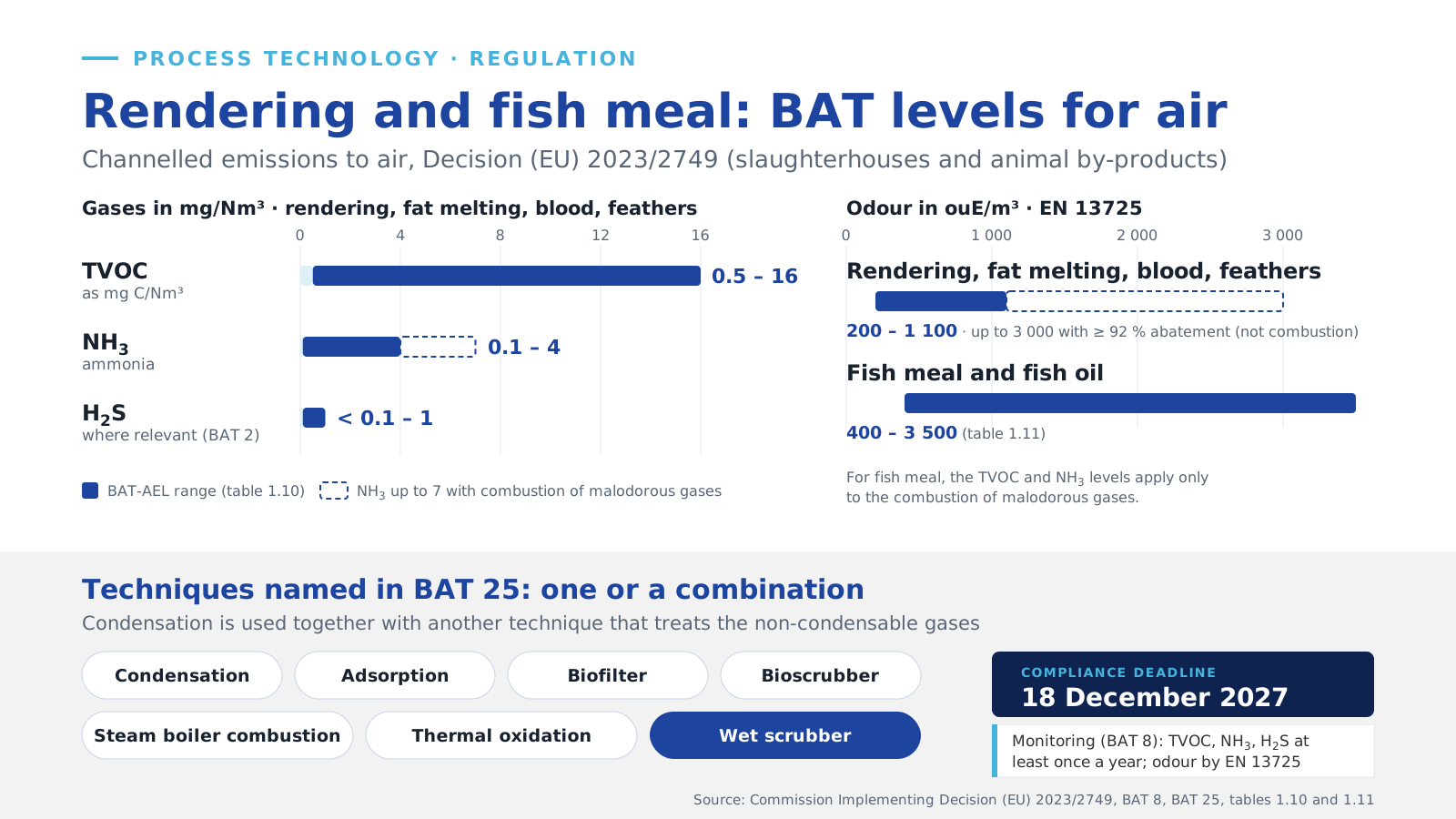
On 18 December 2023 the European Commission published the BAT conclusions for slaughterhouses, animal by-products and/or edible co-products industries, the SA BAT conclusions. Rendering plants, fat melters, blood and feather processors and fish meal and fish oil producers under the Industrial Emissions Directive have four years to bring their permits and their emissions in line. That period ends on 18 December 2027.
For the processing of animal by-products the decision sets BAT-associated emission levels (BAT-AELs) for odour concentration, total volatile organic carbon, ammonia and hydrogen sulphide, plus levels for dust, NOx and SOx where malodorous gases are burned in a thermal oxidiser. It does not prescribe one technique: BAT 25 lists seven, from condensation and biofilters to thermal oxidation and wet scrubbers, to be used alone or in combination. This article summarises the levels and their conditions, what the decision asks for on odour management, what a wet scrubber can and cannot do on this gas, and the monitoring that comes with it.
01 Who the SA BAT conclusions apply to
Commission Implementing Decision (EU) 2023/2749 covers three activities from Annex I to the Industrial Emissions Directive: slaughterhouses with a production capacity above 50 tonnes per day (6.4(a)), the disposal or recycling of offal and other animal by-products with a treatment capacity above 10 tonnes per day (6.5), and independently operated waste water treatment whose main pollutant load comes from these activities (6.11). It also covers the processing of animal by-products and edible co-products that falls under points 6.4(b)(i) and 6.5 of Annex I: rendering, fat melting, feather processing, fish meal and fish oil production, blood processing and gelatine manufacturing.
Several associated activities are included as well, among them the combustion of meat-and-bone meal and animal fat, and the combustion of malodorous gases, including non-condensable gases, in thermal oxidisers or steam boilers. The production of food beyond standard cuts and poultry cuts is not covered; it falls under the BAT conclusions for the food, drink and milk industries.
Under Article 21 of the Industrial Emissions Directive, the competent authority must reconsider the permit and the installation must comply within four years of the publication of new BAT conclusions for its main activity. The SA BAT conclusions were published in the Official Journal on 18 December 2023, so the date is 18 December 2027.
The revised directive, IED 2.0, adds a further step once Member States have transposed it: the permit must set the strictest emission limit value the installation can achieve with BAT, based on an assessment of the entire BAT-AEL range. The lower end of each range in this article is therefore as relevant as the upper end. National transposition is running late; see our news item on the IED 2.0 infringement procedures.
02 BAT-AELs for channelled emissions to air
The air emission levels that matter for a scrubber are in tables 1.10 and 1.11, which belong to BAT 25 for installations processing animal by-products. Each value is the average over the sampling period: three consecutive measurements of at least 30 minutes each, or a more representative procedure where 30 minutes is not suitable, as for odour. Gas concentrations refer to dry gas at 273.15 K and 101.3 kPa, odour concentration to wet gas at 293 K, all without correction for oxygen. Where several sources, such as dryers, share one stack, the level applies to the combined discharge.
| Process | Parameter | BAT-AEL | Conditions |
|---|---|---|---|
| Rendering, fat melting, blood and/or feather processing (table 1.10) | Odour concentration | 200–1 100 ouE/m³ | Up to 3 000 for techniques other than combustion, if abatement is at least 92 % or process odour is not perceptible in the treated gas |
| TVOC | 0.5–16 mg C/Nm³ | – | |
| NH₃ | 0.1–4 mg/Nm³ | Up to 7 where malodorous gases are burned | |
| H₂S | < 0.1–1 mg/Nm³ | Only where H₂S is identified as relevant in the inventory of BAT 2 | |
| Fish meal and fish oil production (table 1.11) | Odour concentration | 400–3 500 ouE/m³ | – |
| TVOC / NH₃ | 1–14 mg C/Nm³ / 0.1–7 mg/Nm³ | Only for the combustion of malodorous gases | |
| Combustion of malodorous gases in thermal oxidisers (table 1.3) | Dust / NOx / SOx | < 1–5 / 50–200 / 6–100 mg/Nm³ | Dust and NOx ranges only with natural gas as the sole fuel; NOx up to 350 for recuperative thermal oxidisers |
Two points in the footnotes are easy to miss. For fish meal and fish oil, the TVOC and ammonia levels apply only where the malodorous gases are burned; a fish meal plant that treats its air in a scrubber or biofilter is held to the odour level. And for rendering, the relaxation of the odour level to 3 000 ouE/m³ depends on a demonstrated abatement efficiency, which means measuring odour before and after the abatement, not only at the stack.
Slaughterhouses have no air BAT-AELs in this decision. They are covered by the odour management requirements in section 03, and odour monitoring applies to them only where odour is identified as relevant.
03 What the decision asks for on odour
The decision approaches odour in three layers. None of them is a single piece of equipment.
An odour management plan (BAT 18)
Part of the environmental management system, with a protocol of actions and timelines, a protocol for odour monitoring, a protocol for responding to odour incidents such as complaints, and a prevention and reduction programme that identifies the sources and their contributions. It applies where an odour nuisance at sensitive receptors, such as homes, schools or neighbouring workplaces, is expected or has been substantiated.
Prevention at the source (BAT 19)
Regular cleaning of installations and storage areas, cleaning and disinfection of vehicles and containers after unloading, reception and storage in enclosed ventilated buildings, minimising biological degradation of the raw material, and air extraction as close as possible to the point where the odour is generated. The extracted air may then be treated under BAT 25.
Abatement of the extracted air (BAT 25)
One or a combination of seven techniques: condensation, adsorption, biofilter, combustion of malodorous gases in a steam boiler, thermal oxidation, wet scrubber and bioscrubber. Condensation is used together with one or more of the others, which treat the non-condensable gases.
The decision does not rank these techniques or say which combination suits which plant. Its description of the wet scrubber is short: the removal of gaseous or particulate pollutants by mass transfer to a liquid, often water or an aqueous solution, which may involve a chemical reaction, for example in an acid or an alkaline scrubber. For thermal oxidisers, BAT 15 also mentions wet scrubbing as a way to remove dust, NOx and SOx after combustion.
04 Where a wet scrubber fits
Air from rendering and from blood, feather and fish meal processing is a mixture. Ammonia and amines, hydrogen sulphide, mercaptans and organic sulphides, and organic compounds such as fatty acids each behave differently in a scrubber, which is why odour scrubbers in this sector usually have more than one stage.
Ammonia and amines
Ammonia is very soluble, but in a water-only loop the liquid soon saturates and the removal falls away. An acid stage, usually dosed with sulphuric acid on pH, binds ammonia and amines as salts. This is the acid scrubber the decision refers to. The bleed carries ammonium nitrogen to the waste water treatment, where the decision's waste water levels apply.
Hydrogen sulphide
H₂S is a weak acid. It is taken up in an alkaline stage only at a high pH, and with a low BAT-AEL range of below 0.1 to 1 mg/Nm³ the margin is small. An oxidising agent in the scrubbing liquid converts it instead of only dissolving it.
Mercaptans and sulphides
Mercaptans are only partly absorbed by caustic, and organic sulphides such as dimethyl sulphide not at all. These compounds have very low odour thresholds and often decide the odour result. In our odour scrubbers they are treated in oxidative stages with sodium hypochlorite, dosed on pH and free chlorine, followed by a caustic stage. The decision itself does not name oxidising scrubbers.
Organic compounds and fat
Short-chain fatty acids such as butyric acid are absorbed in an alkaline stage. Organic compounds with low water solubility pass a scrubber largely untouched, and they count towards both TVOC and odour. Fat aerosol from cookers and dryers fouls whatever comes after it, so it is removed early.
That last point is where honesty matters. A scrubber that removes ammonia and hydrogen sulphide well can still leave an odour concentration above the range, because olfactometry responds to every odorant in the gas, not only the ones the scrubber chemistry is designed for. That is why the decision allows a combination of techniques, and why many plants use one: the concentrated cooker vapours are typically condensed and the non-condensable gases burned in a thermal oxidiser or steam boiler, while the large air flows from buildings and process areas go to a scrubber, a biofilter, or a scrubber followed by a biofilter. Which combination is needed depends on the plant, and can only be settled by measuring the gas.
Lechler builds open spray scrubbers: spray banks, droplet separators and an integrated buffer, with no packing to clog with fat or salt. See the industry page for rendering and animal proteins and the references odour scrubber for offal processing, odour scrubber for drying ovens (food to feed) and scrubber for ammonia and VOC removal.
05 What decides where in the range a plant lands
Reaching the upper end of the ranges is a matter of correct design. The lower end depends on effects that hardly matter at higher concentrations.
A scrubber treats only what the extraction delivers. Odour that escapes from open reception halls, doors or storage is not in the stack measurement but is what the neighbours notice. BAT 19 starts here for a reason.
Mixing a small, concentrated stream into a large volume of building air dilutes it but does not remove it: the mass emitted and the odour load on the surroundings stay the same. Treating concentrated streams separately usually gives a smaller and more effective installation.
Air from cookers and dryers is warm and close to saturation. It cools in the scrubber and water condenses into the liquid, which dilutes the chemistry and raises the level. The buffer, overflow and dosing must be designed for that, not only for the pollutant load.
Raw material, batch changes and cleaning cause peaks. Dosing on measured pH, free chlorine or redox follows the load; a fixed chemical feed does not.
Droplets that leave the stack carry dissolved compounds and salts with them. A droplet separator sized for the actual gas velocity, and kept clean, is part of the performance.
Odour is measured by dynamic olfactometry to EN 13725, with a human panel. Its uncertainty is much larger than that of a gas analyser, so a result close to the limit says little. See Odour Concentration and Meeting the Limit Is Not the Same as Proving It.
06 Monitoring requirements
BAT 8 sets the minimum monitoring frequency for channelled emissions to air. Measurements are carried out, as far as possible, at the highest expected emission state under normal operating conditions.
| Parameter and process | Standard | Minimum frequency |
|---|---|---|
| TVOC, rendering, fat melting, blood and/or feather processing | EN 12619 | Once every year |
| NH₃, rendering, fat melting, blood and/or feather processing | EN ISO 21877 | Once every year |
| H₂S, rendering, fat melting, blood and/or feather processing, where relevant | No EN standard | Once every year |
| Odour concentration, rendering, fat melting, blood, feather, fish meal and fish oil | EN 13725 | Periodic (see note) |
| Dust, NOx, SOx, CO, combustion of malodorous gases | EN 13284-1, EN 14792, EN 14791, EN 15058 | Once every year |
A yearly measurement shows compliance at one moment. Logging pH, free chlorine or redox, liquid flow and the pressure drop over the droplet separator shows what the scrubber did in between, and measuring inlet and outlet at the same time gives the actual removal efficiency, which the 92 % condition for odour asks for. See Simultaneous Scrubber Testing with Analysers.
07 What to do before 18 December 2027
Check whether and where the decision applies
Compare the plant with the activities in section 01 and list the emission points: reception and storage, cookers, presses, dryers, mills, building ventilation and any combustion of malodorous gases.
Complete the waste gas inventory
BAT 2 asks for flow, temperature and the concentrations of relevant substances per waste gas stream. Whether the H₂S level applies, and whether odour must be monitored at a slaughterhouse, depends on that inventory.
Measure the actual emission
Use measured values at the highest expected emission state, including odour before and after the abatement. See Measuring an Unknown Emission.
Close the gap
An existing scrubber can often be improved with an additional stage, controlled dosing or a better droplet separator. Where odour remains above the range, a combination with another technique may be needed. See Upgrade or Replace?
Frequently asked questions
Why is the deadline 18 December 2027?
Decision (EU) 2023/2749 was adopted on 11 December 2023 and published in the Official Journal on 18 December 2023. The Industrial Emissions Directive gives four years from publication to reconsider permits and bring installations into compliance.
Is wet scrubbing accepted as a best available technique?
Yes. The wet scrubber is technique (f) in BAT 25 for odour, organic compounds, H₂S and NH₃ from the processing of animal by-products, and BAT 15 names wet scrubbing for dust, NOx and SOx after a thermal oxidiser. The decision presents it as one option among seven, to be used alone or in combination.
Can a scrubber alone meet the odour level?
Sometimes. It depends on which compounds carry the odour, and on how much of it the chemistry can absorb or oxidise. A scrubber with acid, oxidising and alkaline stages covers ammonia, amines, sulphur compounds and fatty acids; poorly soluble organic odorants need another technique. Only a measurement of the actual gas answers this for a specific plant.
What does the 92 per cent condition mean?
For rendering, fat melting, blood and feather processing, the upper end of the odour range may be up to 3 000 ouE/m³ instead of 1 100 when the abatement is not combustion and its efficiency is at least 92 %, or when process odour is not perceptible in the treated gas. Demonstrating the efficiency requires odour measurements before and after the abatement.
Does the decision set odour levels for slaughterhouses?
No. The odour BAT-AELs apply to the processing of animal by-products and to fish meal and fish oil. Slaughterhouses fall under the odour management plan and the prevention techniques of BAT 18 and BAT 19, and monitor odour only where the inventory shows it is relevant.
What if an installation cannot reach the BAT-AEL in time?
The directive allows the competent authority to grant a derogation in specific cases, based on an assessment showing that the costs would be disproportionate to the environmental benefit. This is an exception with strict conditions. Improving collection and abatement is usually the faster route.
Source: Commission Implementing Decision (EU) 2023/2749 (SA BAT conclusions), Official Journal L series of 18 December 2023 · Standards referenced: EN 13725 (odour), EN 12619 (TVOC), EN ISO 21877 (NH₃), EN 13284-1 (dust), EN 14792 (NOx), EN 14791 (SOx), EN 15058 (CO)
't Woud 59, 3232 LN Brielle, The Netherlands · +31 181 419 419
Open spray odour scrubbers for rendering, animal by-products and food to feed, from emission survey to verified performance.