
News · Regulation · October 2026
On 4 November 2026 the four-year transition period for the ferrous metals processing BAT conclusions ends. Pickling lines, acid regeneration plants and galvanisers must then meet the emission levels for HCl, HF and SOx.
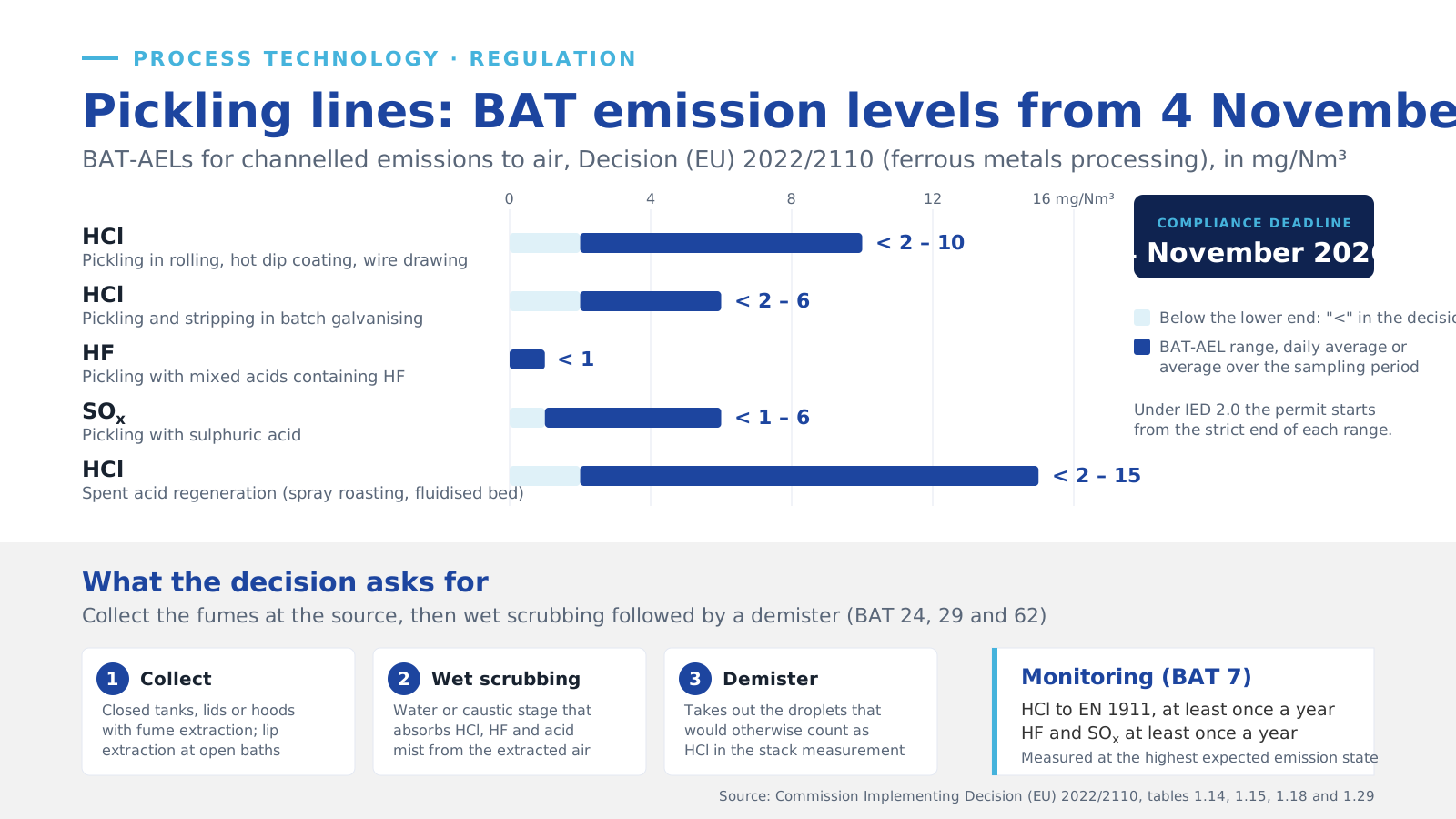
On 4 November 2026, the four-year transition period for the BAT conclusions for the ferrous metals processing industry (Decision (EU) 2022/2110) ends. From that date, permits of hot rolling, cold rolling, wire drawing, hot dip coating and batch galvanising installations under the Industrial Emissions Directive must reflect the BAT-associated emission levels for channelled emissions to air, and the installations must comply with them.
What applies
The FMP BAT conclusions cover hot rolling mills above 20 tonnes of crude steel per hour, hot dip coating and batch galvanising above 2 tonnes per hour, and the chemical surface treatment of ferrous metals in vats above 30 m³ in cold rolling, wire drawing and batch galvanising, including the associated acid recovery. For pickling they set emission levels for hydrogen chloride (below 2 to 10 mg/Nm³, below 2 to 6 in batch galvanising), hydrogen fluoride (below 1 mg/Nm³) and sulphur oxides (below 1 to 6 mg/Nm³), and for acid regeneration plants levels for dust, HCl, SO₂ and NOx. The technique named in each case is the same: collect the fumes at the source, then wet scrubbing followed by a demister.
Under the revised Industrial Emissions Directive, permits will also have to be based on the strictest level an installation can achieve within each range. The Netherlands has not yet completed its transposition; see our news item on the IED 2.0 infringement procedures.
An overview of all acid-related emission levels, the scrubber chemistry per acid, the points that decide the strict end of the range and the monitoring requirements is in our Knowledge article FMP BAT Conclusions: Emission Levels for Pickling Lines and Galvanisers.
Where to start
Measure what the pickling line actually emits at the highest expected load, check whether the extraction captures the fumes, and compare the result with the full BAT-AEL range. Lechler Process Technology carries out emission surveys, upgrades existing scrubbers and builds two-stage polypropylene scrubbers for pickling, anodising and galvanising lines. See our pickling bath scrubber reference or contact our scrubber specialists.
't Woud 59, 3232 LN Brielle, The Netherlands · +31 (0)181 419 419