
Project Execution · Resource Efficiency
What a wet scrubber consumes in water, chemicals and energy is decided during the project, not afterwards in operation. How Lechler, as EPC contractor and equipment manufacturer in one, measures, designs, builds and proves a system that uses no more than the process needs.
Ask who is responsible for the emission limit of a new scrubber and you get a name. Ask who is responsible for how much water, caustic and electricity it will use for the rest of its life, and in a project with several parties the answer is usually: nobody in particular. The engineering firm sizes the column, the equipment supplier delivers what is specified, the contractor installs it, and the consumption lands on the operator's utility bills.
Lechler delivers gas scrubber systems as EPC turnkey contractor and Original Equipment Manufacturer in one. This article follows the resources through such a project: how the gas is measured inline before anything is designed, how water, reagent and energy are minimised in the engineering, how analyser-based control is built into the system, how its performance is verified at commissioning, and how the baseline recorded there keeps the savings measurable in service. It brings together two earlier articles: EPC Turnkey Scrubber Systems and Do You Really Know What Your Process Consumes?
01 Consumption is a project decision
Water, energy and chemicals rarely appear as a line of their own on a cost report. They are spread over the water bill, the electricity bill and the chemicals budget, and nobody links them to how the gas cleaning is actually running. In a project that is split between an engineering firm, an equipment supplier and a site contractor, the same thing happens before the plant even exists: each party answers for its own scope, and the consumption of the finished system is the outcome of three scopes that nobody owns as a whole.
Lechler brings the entire project under one roof. As EPC turnkey contractor and Original Equipment Manufacturer in one, the team that measures the gas is the team that designs the absorber, builds the dosing and control systems, commissions the plant and supports it afterwards. That changes what can be promised about consumption, because the design data, the equipment and the operating data all come from the same hands.
Multi-party project
- Engineering firm, equipment supplier and site contractor each hold their own contract
- The design is based on whatever process data happens to be available
- Consumption is the result of three separate scopes; no single party is accountable for it
Lechler EPC
- One team measures, designs, builds, commissions and supports
- Minimising water, absorption liquid, chemicals and energy is a core engineering objective
- Consumption is designed in, verified at commissioning and followed afterwards
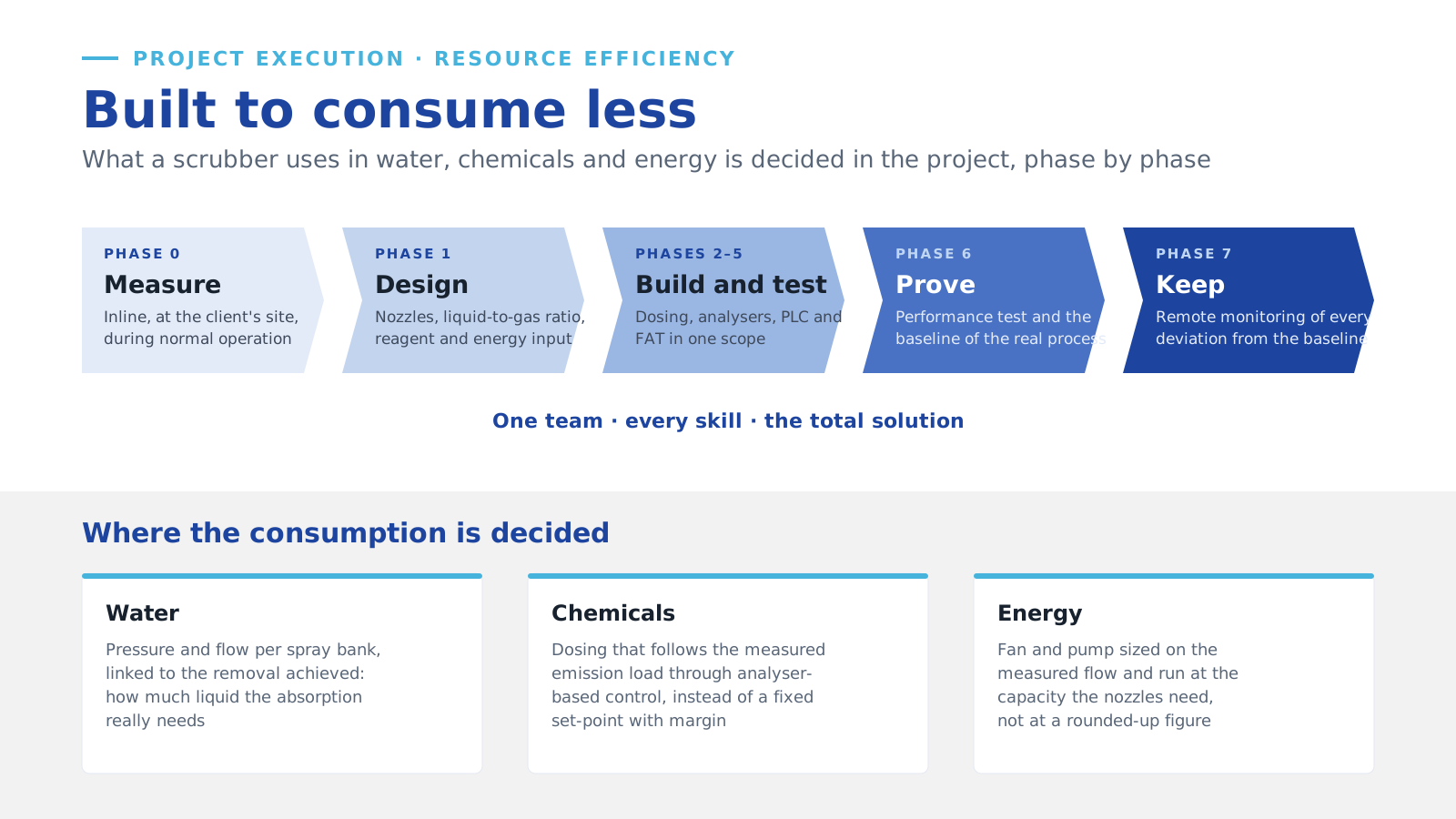
0 Process data Inline measurement and evaluation at the client's site Where gas composition is unknown
- 1EngineeringL/G ratio, reagent and energy input designed to the measured load
- 2ProductionColumn, pumps, dosing systems in one scope
- 3ControlPLC and analysers built into the system
- 4FATFactory acceptance test
- 5InstallationOn-site erection and integration
- 6CommissioningPerformance test and baseline
- 7ServiceRemote monitoring against the baseline
One team · every skill · the total solution
The rest of this article walks through those phases and asks one question at each of them: what is decided here about what the system will consume?
02 Phase 0: measure before you design
Good decisions start with good data. Where the gas composition entering the scrubber is unknown or insufficiently characterised, Lechler carries out inline measurements with process analysers directly at the client's installation. The analysers are connected in or next to the running process, production continues, and the measurement runs long enough to catch start-ups, peaks and quiet periods.
For consumption, this first measurement matters more than any later optimisation. A scrubber that is sized on an assumed load carries that assumption, and the margin on top of it, for the rest of its life: in the fan, in the recirculation pump, in the reagent set-point. A scrubber that is sized on the measured load does not. The measurement becomes the technical basis for absorber sizing, reagent selection and process design, so that the system is engineered to match reality, not assumptions.
| Measured before design | What it decides about consumption |
|---|---|
| Emission profile | Which components are present and at what concentrations. Determines the reagent, the liquid-to-gas ratio and the absorber size, and so the water and chemicals the system will need. |
| Flow and temperature | The gas volume the fan has to move and the liquid the column has to circulate. Sizing the fan and pump on the real flow instead of a rounded-up figure sets the energy consumption for the life of the plant. |
| Peak loads and variation | Because the measurement is continuous, it records the dynamics of the process. The system is designed to perform under the heaviest conditions, and the controls are designed to turn down when those conditions are not present. |
What such a measurement campaign has to deliver to serve as a design basis is set out in Measuring an Unknown Emission. The same first measurement works on an existing installation, where it produces an optimisation report instead of a design basis; see Do You Really Know What Your Process Consumes?
03 Phase 1: engineering for the lowest consumption that still performs
All technical development is carried out in-house. Lechler performs the mass transfer calculations, absorber sizing, liquid-to-gas ratio analysis, stress calculations and material selection, and every engineering decision is made by the same team that will subsequently build and install the system. Resource efficiency is part of that engineering from the outset: by optimising reagent consumption, liquid-to-gas ratio and energy input at the design stage, every system is designed for the lowest resource consumption that still meets the required performance.
Minimising the use of water, absorption liquid, chemicals and energy is not an afterthought. It is a core engineering objective.
The nozzle is the lever
The Lechler Group makes spray nozzles and mist eliminators, and in an open spray scrubber the nozzles are the heart of the process: the column contains spray levels, a mist eliminator and a sump, and nothing in between. Which nozzle gives the right droplet size for this process gas, how much liquid is really needed for the absorption required, and how low the spray pressure can go without losing removal efficiency are engineering questions that decide the water and pump energy of the system directly. Answering them from measured gas data rather than from a catalogue is what the first measurement is for.
Where the energy goes
An open column without packing has a low gas-side pressure drop, which keeps the fan's work small; the background is in Open Spray Scrubbers. But a low pressure drop is not the same thing as low energy consumption: with no packing to hold liquid, the open column creates its contact area entirely from droplets, which means more absorption liquid per unit of gas, and that liquid has to be pumped. The engineering question is therefore not how to eliminate the energy but where to spend it, and a droplet field that is sized, positioned and staged for the measured duty spends less of it than one designed with margin on an assumption.
04 Phases 2 to 5: building the control in
A design for low consumption only delivers if the system can follow the load in operation. That is a matter of hardware and software, and in an EPC project both are part of the scope. Lechler manages the entire supply chain, from construction material to auxiliary equipment, and core equipment and electrical cabinets are made in-house, so the dosing systems, instrumentation and PLC are specified, built and tested by the people who designed the process.
- Recirculation pumps
- Chemical dosing systems
- Blowers
- Instrumentation
- Process analysers
- Electrical cabinets and PLCMade and programmed in-house
- Factory acceptance testWithin one quality framework
The difference shows in how the system is controlled. A scrubber run on fixed set-points has to carry conservative operating margins, because nobody knows from minute to minute what the gas is doing; the price is reagent that is over-dosed and water and energy that are consumed for nothing. Lechler specifies and integrates process analysers for continuous monitoring of gas composition, pollutant concentrations and absorption efficiency. They provide real-time data for dynamic control of reagent dosing, liquid flow rates and other system parameters, which is where the savings in chemicals, water and energy during operation come from.
Fixed set-points
- Conservative operating margins
- Risk of over-dosing reagents
- Unnecessary consumption of water, chemicals and energy
Analyser-based control
- Real-time data on gas composition and absorption efficiency
- Dynamic control of dosing, liquid flow and system parameters
- Continuous adaptation to actual process conditions
05 Phase 6: proving it at commissioning
Project completion follows a structured commissioning programme: cold commissioning without process gas, hot commissioning under real conditions, the site acceptance test and the performance test. At each stage the system is verified against the parameters agreed for the project, and formal handover only takes place once all performance criteria have been demonstrably met.
Those parameters are not only about emissions. Pressure drop is the fan's energy in disguise, and energy consumption can be measured outright. For water and chemicals the commissioning phase does something else that matters just as much: our engineers record validated correlations between emission levels, process parameters and dosing rates. Together they form the baseline, the objective zero measurement of how this system performs on this gas, and the reference against which every future deviation, and every future saving, is measured.
The client starts operation with a system that has proven its performance on site, and with a baseline that makes its water, chemical and energy use measurable from day one.
06 Phase 7: keeping the savings
A system that is handed over at its optimum does not stay there by itself. Nozzles age: wear drives the pressure per spray bank down, plugging drives it up, and either way the liquid distribution drifts away from the design. Dosing that was matched to the load at commissioning can drift when the process changes. How these signals are read on a spray scrubber, and why they are the earliest warning, is explained in Meeting the Limit Is Not the Same as Proving It.
Because the system measures inline and logs in real time, the data is available through a secure remote platform. Our specialists review the process data remotely and step in as soon as trends deviate from the baseline, without anyone needing to come to site, and our engineers can support the installation through the PLC; see PLC control and remote support. After installation the client receives a periodic overview of emission trends, chemical consumption, energy profile and maintenance events: not surprises, but progress that can be shown.
07 Where the savings come from
The savings differ per installation, which is why the project starts with a measurement rather than with a promise. These are the levers that the measured data and the integrated control act on.
Water
Measuring pressure and flow per spray bank and linking them to the emission reduction achieved tells us how much water is really needed. Many installations use more than necessary because the nozzles are not matched to the current process gas. Blowdown frequency, make-up water and nozzle configuration can then be matched to the actual load.
Chemicals
Knowing the relation between emission concentration and chemical dosing precisely prevents overdosing. That is where the savings on acids, caustic and other process chemicals come from, and it is the relation that analyser-based control uses minute by minute.
Energy
Unnecessary overpressure at the fan or a recirculation flow higher than the nozzles need raises the energy bill, and fan power falls steeply as speed comes down. A system that is sized on the measured load and controlled on live data runs fan and pumps at the capacity that is actually needed.
Emissions
Continuous monitoring shows directly whether the scrubber is operating under the right conditions, so a drop in pH is seen before it becomes an emission peak. Lower emissions often also mean that less product, solvent or raw material is lost to the stack.
08 What the client gets
Lechler Process Technology in Brielle is part of the Lechler Group, the group that makes the spray nozzles and mist eliminators inside the columns. That is why the emission data of a Lechler scrubber can be linked directly to the behaviour of the nozzles inside it, rather than stopping at the stack.
From one EPC partner that also answers for consumption:
- A design built on measured process data, not on an oversized standard solution
- Water, absorption liquid, chemicals and energy minimised as an engineering objective, not an afterthought
- Analyser-based control delivered as part of the system, so consumption follows the load
- Performance verified on site before handover
- A baseline from commissioning, and remote monitoring against it, so savings remain measurable throughout the operational life
The full project sequence, phase by phase, is described in EPC Turnkey Scrubber Systems. What the measurements involve, and how they work on an existing installation, is covered in Do You Really Know What Your Process Consumes? For an existing scrubber that is due for improvement rather than replacement, see Upgrade or Replace?
Frequently asked questions
How do we know afterwards what the system actually saves?
Against the baseline. At commissioning the correlations between emission levels, process parameters and dosing rates are recorded for your gas and your system. Water, chemical and energy use are logged from then on, so a deviation or an improvement is shown against a measured reference rather than against a design figure.
We have no process data. Where does the project start?
With an inline measurement at your site, during normal operation and without a shutdown. Gas composition, concentrations, flow, temperature and peak loads become the design basis, so the scrubber is sized on the measured load instead of on an assumption.
Does this only apply to a new scrubber?
No. The same first measurement on an existing installation shows where water, energy or chemicals are being wasted and results in an optimisation report: a different nozzle selection, an adjusted dosing strategy, energy-saving settings or targeted retrofit measures.
Discuss your emission challenge with our engineers. Lechler Process Technology BV · 't Woud 59, 3232 LN Brielle, The Netherlands · +31 181 419 419