
News · Regulation · October 2026
By 11 December 2026, EU Member States must have transposed the revised Ambient Air Quality Directive. From 1 January 2030 its limit values for fine particulate matter, nitrogen dioxide and sulphur dioxide are half or less of today's.
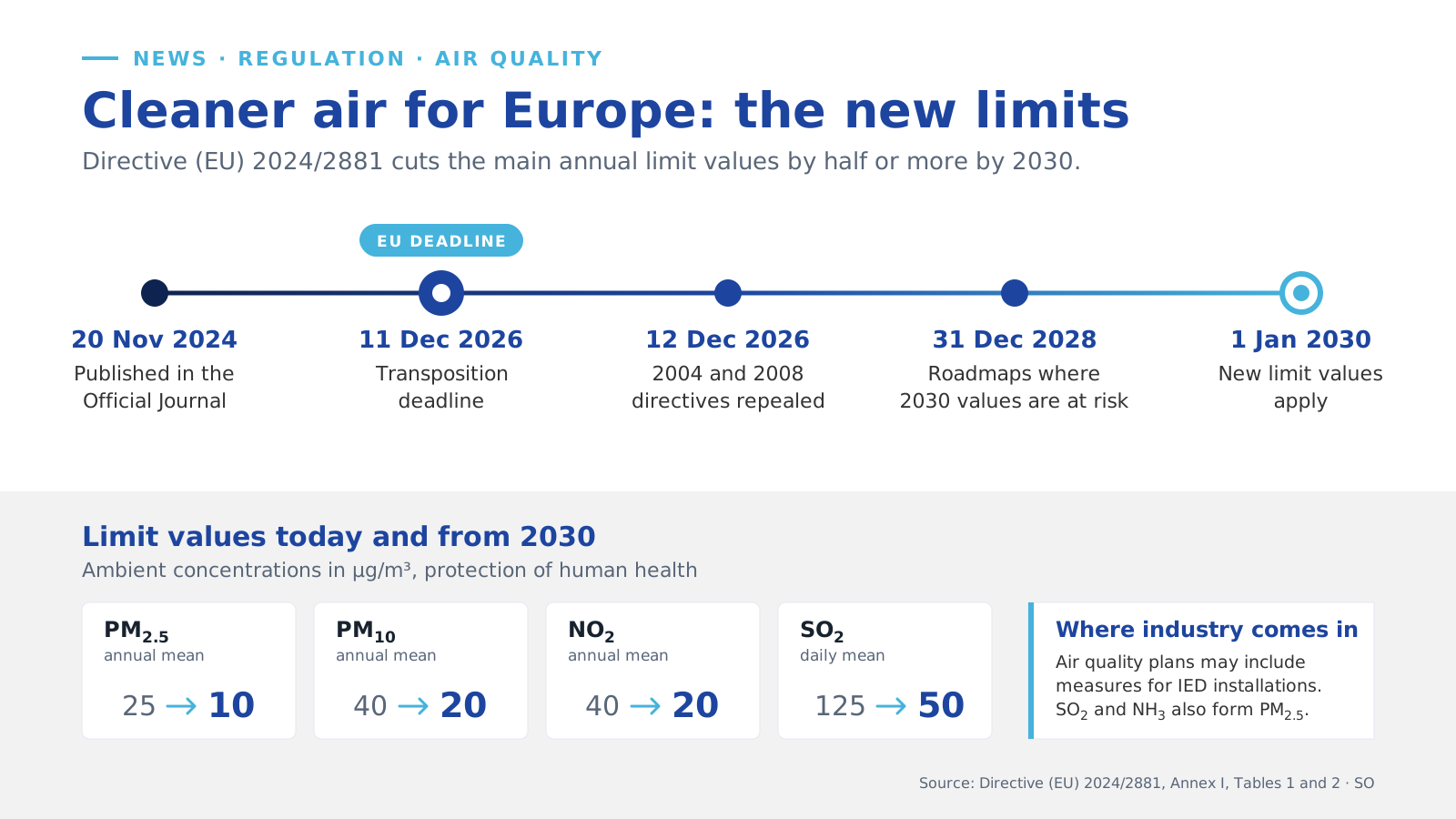
Directive (EU) 2024/2881 on ambient air quality and cleaner air for Europe replaces the 2004 and 2008 air quality directives. Member States must bring their national rules in line by 11 December 2026; the old directives are repealed the day after. The stricter limit values themselves must be met from 1 January 2030, and where that is at risk, governments have to draw up roadmaps well before then.
What changes
The directive sets limit values for the concentration of pollutants in ambient air, averaged over an hour, a day or a calendar year. The values that apply until the end of 2029 are the ones from the earlier directives. The values to be attained by 1 January 2030 are considerably lower and move closer to the World Health Organization's guideline levels.
| Pollutant | Averaging period | Until 2030 | From 1 January 2030 |
|---|---|---|---|
| PM2.5 | Calendar year | 25 | 10 |
| PM2.5 | 1 day | – | 25, max. 18 exceedances a year |
| PM10 | Calendar year | 40 | 20 |
| PM10 | 1 day | 50, max. 35 exceedances | 45, max. 18 exceedances |
| NO₂ | Calendar year | 40 | 20 |
| NO₂ | 1 hour | 200, max. 18 exceedances | 200, max. 3 exceedances |
| SO₂ | Calendar year | – | 20 |
| SO₂ | 1 day | 125, max. 3 exceedances | 50, max. 18 exceedances |
A new daily limit for NO₂ (50 µg/m³), a lower limit for benzene and a binding limit value instead of a target value for benzo(a)pyrene complete the picture. Where a limit value cannot be met in time despite a credible plan, the directive allows a Member State to postpone the 2030 deadline for a specific zone, usually to 2035 and in narrowly defined cases to 2040, subject to strict conditions and a roadmap.
Where the Netherlands stands
The Dutch implementation runs through the Environment and Planning Act (Omgevingswet), the Environmental Quality Decree (Besluit kwaliteit leefomgeving) and the Environment and Planning Regulation. The bill amending the Act, number 36 879, was adopted by the House of Representatives on 22 September 2026 and is now with the Senate, whose committee is due to report on 3 November 2026. An entry-into-force date will be set by royal decree. Where the 2030 values are at risk in a zone, the authorities must set out in a roadmap how they will still be met; the Dutch government expects these roadmaps by the end of 2028 at the latest.
What it means for industrial sites
The directive does not set emission limits for chimneys. It sets the quality of the air outside the fence, and it is up to Member States to get there. That still reaches industrial installations in two ways. First, the list of measures for air quality plans and roadmaps explicitly includes measures to reduce air pollution from industrial sources under the Industrial Emissions Directive. Second, the Industrial Emissions Directive itself requires additional permit conditions where an environmental quality standard needs more than the best available techniques deliver. A site in or near a zone with an exceedance can therefore expect closer questions from its permitting authority.
Fine particulate matter is not only emitted as dust. A large part of PM2.5 forms in the atmosphere from gases such as sulphur dioxide, nitrogen oxides and ammonia. That links gaseous emissions to a particle limit value. Wet scrubbing is an established technique for some of these gases: an alkaline scrubber absorbs SO₂, see flue gas desulphurisation, and an acid scrubber absorbs ammonia, see our ammonia scrubbers. For nitrogen oxides it is not the obvious first choice, because nitric oxide hardly dissolves in water. For dust, the result depends on the particle size the scrubber is designed for; see dust scrubbers.
The BAT deadlines for chemical plants (12 December 2026) and for pickling lines (4 November 2026) and the transposition of IED 2.0 (infringement procedures) all fall in the same period. Permits reviewed for one of these reasons are likely to be looked at against the new air quality standards as well.
Where to start
Know what leaves your stacks, not only what the permit says. A measurement at full load shows which pollutants matter and how much headroom there is; see measuring an unknown emission. Lechler Process Technology carries out emission surveys, upgrades existing scrubbers and designs new installations for SO₂, ammonia, acid gases and odour. Contact our scrubber specialists to discuss your situation.
't Woud 59, 3232 LN Brielle, The Netherlands · +31 181 419 419