
News · Regulation · October 2026
On 18 December 2027 the four-year transition period for the BAT conclusions for slaughterhouses and animal by-products ends. Rendering, fat melting, blood, feather and fish meal plants must then meet the emission levels for odour, ammonia, hydrogen sulphide and organic compounds.
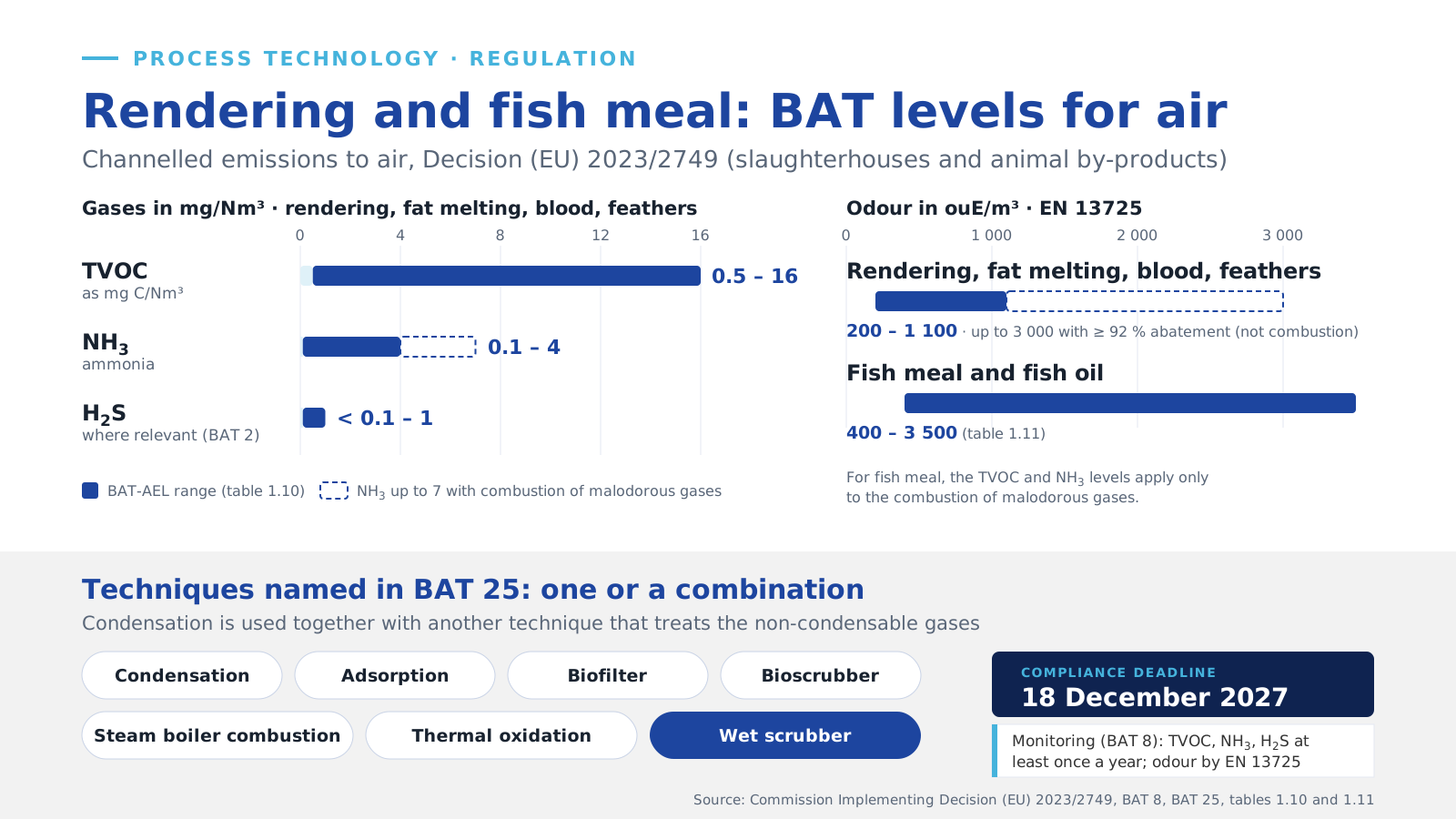
On 18 December 2027, the four-year transition period for the BAT conclusions for slaughterhouses, animal by-products and/or edible co-products industries (Decision (EU) 2023/2749) ends. From that date, permits of installations that process animal by-products under the Industrial Emissions Directive must reflect the BAT-associated emission levels for channelled emissions to air, and the installations must comply with them.
What applies
The SA BAT conclusions cover slaughterhouses above 50 tonnes production per day, the disposal or recycling of offal and other animal by-products above 10 tonnes per day, and the processing of animal by-products such as rendering, fat melting, blood and feather processing, fish meal and fish oil production and gelatine manufacturing. For rendering, fat melting, blood and feather processing they set emission levels for odour (200 to 1 100 ouE/m³), total volatile organic carbon (0.5 to 16 mg C/Nm³), ammonia (0.1 to 4 mg/Nm³) and, where relevant, hydrogen sulphide (below 0.1 to 1 mg/Nm³). For fish meal and fish oil the odour level is 400 to 3 500 ouE/m³.
The decision does not prescribe one technique. It asks for an odour management plan where nuisance is expected, for prevention and extraction at the source, and for treatment of the extracted air with one or a combination of seven techniques, the wet scrubber among them, alongside condensation, adsorption, biofilters, bioscrubbers, thermal oxidation and combustion in a steam boiler.
Under the revised Industrial Emissions Directive, permits will also have to be based on the strictest level an installation can achieve within each range. National transposition is running late; see our news item on the IED 2.0 infringement procedures.
An overview of all emission levels and their conditions, the odour management requirements, the scrubber chemistry per compound and the monitoring requirements is in our Knowledge article SA BAT Conclusions: Emission Levels for Rendering and Fish Meal Plants.
Where to start
Measure what each stack actually emits at the highest expected load, including odour before and after the existing abatement, check whether the extraction captures the odour at the source, and compare the result with the full BAT-AEL range. Lechler Process Technology carries out emission surveys, upgrades existing scrubbers and builds open spray odour scrubbers with acid, oxidising and alkaline stages. See our page on rendering and animal proteins or contact our scrubber specialists.
't Woud 59, 3232 LN Brielle, The Netherlands · +31 181 419 419